Why Is My AC Freezing Up? Causes, Fixes, and Prevention
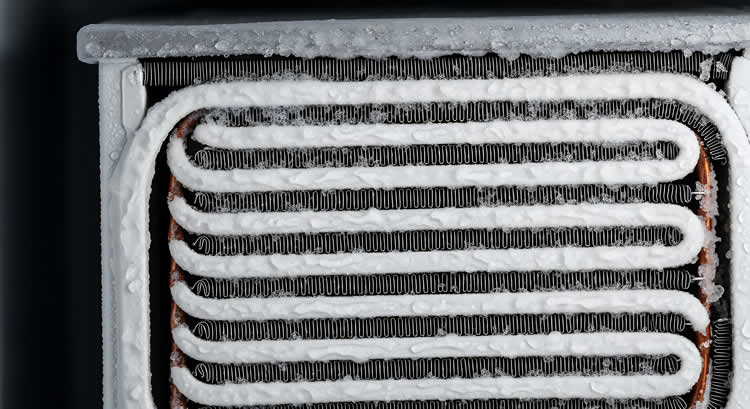
An AC system freezes up when airflow across the evaporator coil drops too low or refrigerant levels fall below the designed charge, causing the coil temperature to plunge below 32°F and freeze the condensation on its surface. The three most common causes are a dirty air filter, low refrigerant from a leak, and a failing blower motor — and in Savannah’s high-humidity climate, a frozen coil can ice over completely in under two hours, shutting down your cooling entirely on the kind of afternoon when you need it most.
Finding ice on your AC is alarming, and the instinct is to call a technician immediately. Before you do, there is a simple first step that resolves the problem roughly 40% of the time without a service call, and understanding why freezing happens in the first place helps you prevent it from recurring. This is one of the most common HVAC problems in coastal Georgia, and it is almost always a symptom of something else rather than a standalone failure.
What to Do Right Now If Your AC Is Frozen
If you have ice on your refrigerant lines, on the outdoor unit, or visible on the evaporator coil inside the air handler, take these steps before calling anyone.
Turn the system off at the thermostat. Do not just switch it from “cool” to “off” — switch the fan setting to “on” so the blower continues running without the compressor engaged. This circulates room-temperature air across the frozen coil, which is the fastest safe way to thaw it. Running the compressor while the coil is frozen risks liquid refrigerant reaching the compressor — a condition called liquid slugging that can cause catastrophic and expensive compressor damage.
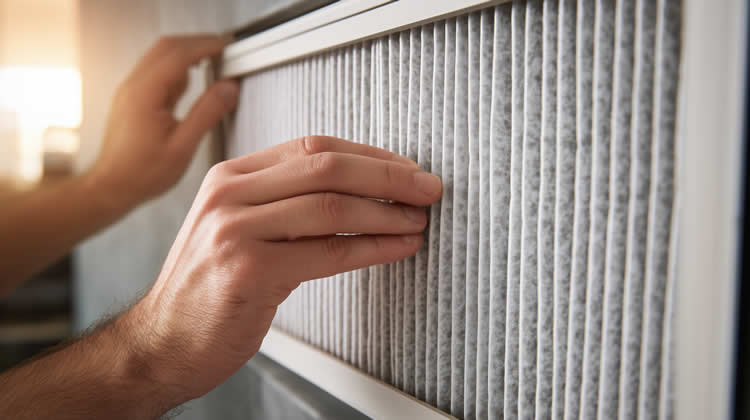
While the coil thaws, check your air filter. Pull it out and hold it up to a light source. If you cannot see light through the filter media, it is severely restricted and is very likely the reason your coil froze. Replace it with a clean filter of the same size and MERV rating. In Savannah homes during peak pollen season — roughly March through May — a standard filter can go from clean to clogged in as little as three to four weeks, far faster than the 90-day replacement interval printed on most filter packaging.
Allow the system to thaw completely before restarting. This takes one to four hours depending on how heavily iced the coil is. You will know it is thawed when water stops dripping from the air handler area and the refrigerant lines running to the outdoor unit are no longer cold to the touch. Once thawed, restart the system normally and monitor it for the next hour. If it cools properly and the lines stay frost-free, a dirty filter was your culprit and you just saved yourself a service call.
If the system freezes again within 24 hours of restarting with a clean filter, the problem is deeper than filtration, and you need a technician.
Cause One: Restricted Airflow
Restricted airflow is the most frequent cause of a frozen evaporator coil, and it is also the most preventable. The physics are straightforward: the evaporator coil is designed to operate with a specific volume of warm air flowing across it. That airflow is what keeps the coil temperature above freezing while the refrigerant inside absorbs heat. When airflow drops below the designed threshold, the coil gets colder than intended, drops below 32°F, and the moisture that naturally condenses on the coil surface during dehumidification turns to ice instead of dripping into the drain pan.
A clogged air filter is the most common airflow restriction and the easiest to fix. But it is not the only one. Closed or blocked supply registers throughout the house reduce system airflow even with a clean filter. Homeowners sometimes close vents in unused rooms thinking it saves energy — in reality, it restricts airflow to the coil and can cause freezing, especially if more than 20-30% of the registers are closed simultaneously.
Ductwork problems cause airflow restriction that no filter change will fix. Collapsed flex duct in an attic — common in Savannah-area homes where attic temperatures exceed 140°F and the outer jacket of flex duct degrades over time — can reduce airflow to a section of the house dramatically. Undersized ductwork from the original installation, particularly in older Savannah homes that have had HVAC systems retrofitted into spaces not originally designed for central air, creates a permanent airflow limitation that makes the system more susceptible to freezing during high-demand periods.
A dirty evaporator coil itself restricts airflow in a way that compounds over time. Dust and biological growth accumulate on the coil fins gradually, narrowing the gaps that air flows through. In Savannah’s humid climate, the coil surface stays wet nearly continuously from April through October, and that persistent moisture acts as an adhesive for airborne particles. A coil that has not been professionally cleaned in three or more years may have enough buildup to reduce airflow by 10-20%, which is enough to cause intermittent freezing on the hottest, most humid days when the system runs longest.
Cause Two: Low Refrigerant
Low refrigerant causes freezing through a different mechanism than airflow restriction, but the visible result is identical. When the refrigerant charge drops below the designed level — always because of a leak, since refrigerant does not get consumed — the remaining refrigerant expands more than intended as it enters the evaporator coil. Greater expansion means a colder coil temperature, and once that temperature drops below freezing, ice formation begins.
The distinguishing feature of a refrigerant-related freeze is that it tends to start at the evaporator coil and progress outward along the suction line toward the outdoor unit. In severe cases, ice can extend all the way from the indoor coil to the outdoor condenser, coating the larger copper refrigerant line in a solid sleeve of frost. Airflow-related freezing tends to concentrate on the evaporator coil itself without extending as far down the line set.
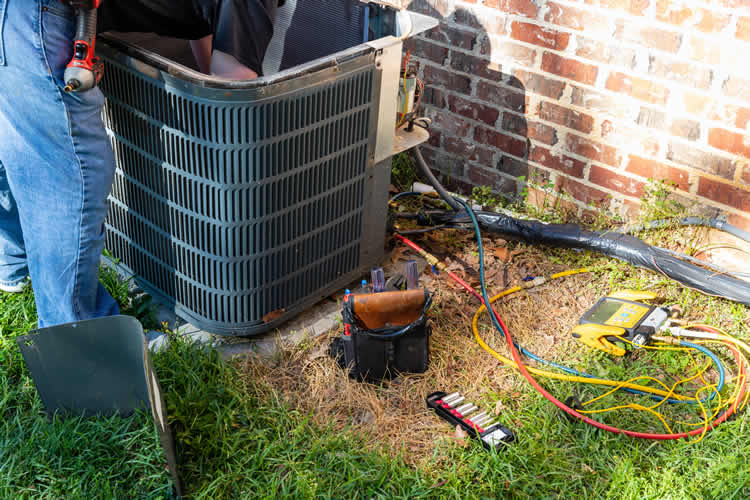
If your system freezes repeatedly after filter replacement and you notice that cooling performance has been declining gradually over weeks or months — not a sudden loss, but a slow trend toward warmer air — low refrigerant from a leak is the most probable cause. This is not a DIY fix. A technician needs to locate the leak, repair it, pull a vacuum on the system, and recharge to the manufacturer’s specified weight. Simply adding refrigerant without repairing the leak means you will be back in the same situation within months.
Savannah’s climate makes refrigerant leaks slightly more consequential than in drier regions because the system’s dehumidification workload is enormous. A system running at 80% of its designed refrigerant charge in Phoenix might still cool adequately because the dry air requires minimal dehumidification. That same 80% charge in Savannah means the system cannot keep up with both the cooling and dehumidification demands of 75-85% relative humidity, so it runs longer, the coil stays colder, and the freezing threshold is reached more easily.
Cause Three: Blower Motor Problems
The blower motor pushes air across the evaporator coil. When it slows down, weakens, or fails entirely, airflow drops and the coil freezes — even with a clean filter and clear ductwork.
A failing blower motor often gives warning signs before it causes a freeze-up. You may notice reduced airflow from the vents throughout the house, not just in one room. The air handler may produce unusual sounds — humming, buzzing, or a grinding noise that indicates bearing wear. Your energy bills may creep up as the motor draws more amperage to maintain diminishing performance.
Variable-speed ECM blower motors, which are standard in most systems installed after 2015, are more sophisticated and more expensive to replace than older single-speed PSC motors. They also communicate diagnostic fault codes in some systems, which a technician can read during a service call to identify the specific failure mode. If your system has an ECM motor that is running at reduced speed due to an internal fault, it may provide adequate airflow under mild conditions but fall short during peak demand — which is why some homeowners experience freezing only on the hottest days when the system runs continuously.
A blower motor replacement in the Savannah market costs $400 to $800 depending on motor type, and it is a repair that typically makes financial sense on systems under 12 years old. On older systems, a blower motor failure often arrives alongside or shortly before other major component failures, making it worth evaluating the system’s overall condition before investing in the repair.
Cause Four: Running the System Too Hard in Mild Weather
This cause surprises homeowners, but it is real and relatively common during Savannah’s shoulder seasons in March, April, and October when daytime temperatures reach the 70s and 80s but nighttime temperatures drop into the 50s or low 60s.
Air conditioning systems are designed to operate with a meaningful temperature difference between indoor and outdoor air. When outdoor temperatures drop below about 60°F and the system is set to cool — perhaps because the house warmed up during the day and the thermostat is still set at 72°F — the refrigerant in the evaporator coil gets colder than it would during normal summer operation because the outdoor condenser is dumping heat into already-cool ambient air. The coil temperature drops below freezing, and ice forms.
This is not a malfunction. It is a physics limitation of the equipment. The fix is simple: on cool nights during the shoulder seasons, turn off the AC and open windows, or set the thermostat’s temperature a few degrees higher so the system cycles less aggressively. If your system has an automatic changeover thermostat, verify that the cooling lockout temperature is set appropriately so it does not attempt to cool when outdoor conditions make freezing likely.
Why Savannah’s Humidity Makes Freezing Worse
Humidity is the accelerant in every freezing scenario. A coil that is borderline — sitting right around 32°F due to a slightly dirty filter or a minor refrigerant deficit — might not freeze in a dry climate because there is not enough moisture in the air to form ice. In Savannah, where the air passing over the coil routinely carries 70-85% relative humidity, there is an enormous amount of moisture available to freeze on contact with a cold surface.
This means that problems which would cause a minor efficiency drop in Denver or Las Vegas cause a full freeze-up in Savannah. The margin for error is smaller here, and the consequences of deferred maintenance are more immediate. A filter that is 80% clogged might reduce airflow without causing freezing in a dry climate. That same filter in Pooler during July will ice over the coil in an afternoon.
It also means that the thawing process generates more water than homeowners expect. A heavily iced evaporator coil in a Savannah home can produce several gallons of meltwater during thawing, and if the drain pan or condensate line cannot handle the volume, you end up with water damage on top of the original freezing problem. Before starting the thaw, verify that the drain pan under the air handler is not already full and that the condensate drain line is flowing freely. If your air handler is in the attic, place towels around the base of the unit as a precaution.
When to Call a Professional
A frozen coil caused by a dirty filter is a homeowner-fixable problem that does not need a service call. Everything else on this list does.
Call a technician if the system freezes again after you have replaced the filter and allowed a full thaw. Call if you see ice extending along the refrigerant line from the indoor unit toward the outdoor unit, which strongly suggests a refrigerant issue. Call if the blower motor sounds abnormal or if airflow from the vents has been noticeably weaker over the past several weeks. And call if this is the second or third freeze event this season, even if replacing the filter resolved it temporarily — recurring freezing suggests an underlying issue that filter changes are masking rather than solving.
At Carriage Heating & Cooling, frozen coil diagnosis is part of our standard service call. We measure refrigerant pressures, test blower motor performance, evaluate airflow throughout the duct system, and identify the root cause rather than just thawing the ice and hoping it does not return. Call (912) 306-0375 for service anywhere in Pooler, Savannah, Richmond Hill, or the surrounding area.