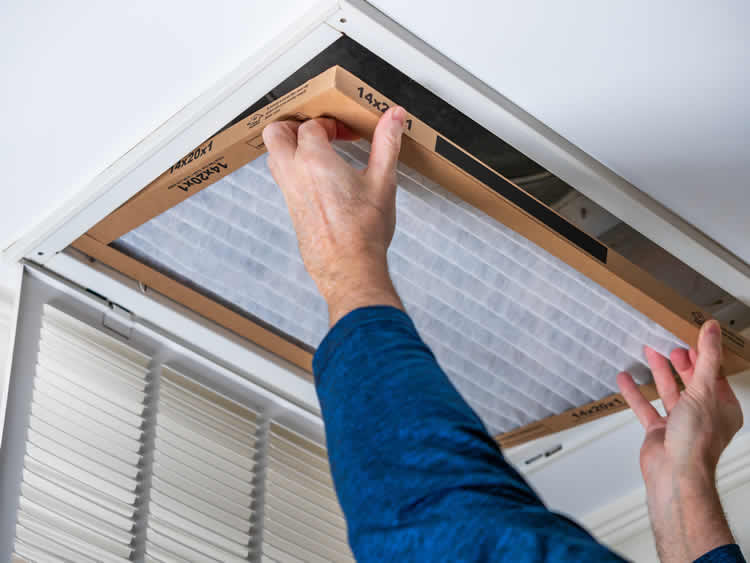
When Should You Replace Your Air Filter? The Real Answer for Coastal Georgia
Replace your HVAC air filter every 30 to 60 days in the Savannah area during the cooling season, not the 90 days printed on most filter packaging. Coastal Georgia’s combination of extreme pollen loads from March through May, year-round high humidity that causes filters to absorb moisture and clog faster, and extended system runtime from April through October means that the national replacement intervals recommended by filter manufacturers are too long for this climate. A filter that would last three months in Minneapolis lasts six weeks in Pooler — and running a clogged filter is not just an air quality problem, it is an equipment damage problem.
This is one of the cheapest and most impactful things you can do for your HVAC system, and it is also one of the most misunderstood. Homeowners either change filters too infrequently because they follow the manufacturer’s generic guidance, or they install the wrong MERV rating thinking higher filtration is always better. Both mistakes cost money — the first through equipment wear and higher energy bills, the second through airflow restriction that can cause the same problems as a dirty filter. Getting filter replacement right for Savannah’s specific conditions is straightforward once you understand what is actually happening inside your system.
Why the 90-Day Guideline Does Not Work Here
Filter manufacturers print replacement intervals based on average national conditions — moderate climate, typical household dust, standard system runtime. None of those averages reflect reality in coastal Georgia.
Savannah consistently ranks among the worst cities in the United States for pollen. The combination of pine pollen (February through April), oak pollen (March through May), and grass pollen (April through September) creates a near-continuous particulate load that is dramatically higher than what filters encounter in the Midwest or Northeast. During peak pine pollen season in March, you can see the yellow dust coating every outdoor surface in Pooler and Savannah — and that same pollen is being pulled through your return vents and into your filter every minute the system runs.
Humidity compounds the pollen problem. A filter operating in 30% relative humidity stays dry, and dry fibers maintain their designed airflow characteristics even as particles accumulate. A filter operating in Savannah’s 60-80% indoor relative humidity absorbs moisture into the filter media itself, which causes the fibers to swell and the gaps between them to narrow. The result is that a filter at 50% particulate capacity in humid air restricts airflow as much as a filter at 75% capacity in dry air. You hit the functional clogging point weeks earlier than the manufacturer’s timeline predicts.
System runtime is the third factor. Your AC in Savannah runs six to seven months per year as a primary system, and during July and August it may run 14 to 18 hours per day. Every hour of runtime pulls air through the filter. A system running 16 hours per day for 60 days processes the same volume of air as a system running 8 hours per day for 120 days. The clock on the calendar is not the relevant measurement — cumulative airflow is, and Savannah’s extended cooling season means your filter processes far more air per month than the national average the manufacturer used to calculate its replacement interval.
How to Tell When Your Filter Actually Needs Replacing
Rather than relying on a calendar, use visual and performance indicators to determine when your specific filter needs changing in your specific home.
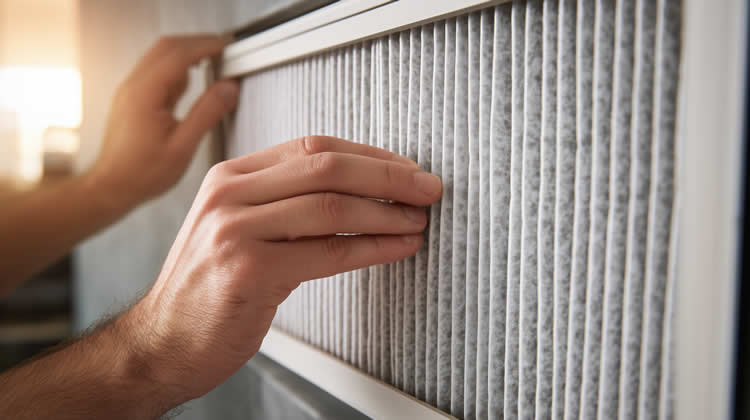
The light test is the simplest method for standard pleated filters. Hold the filter up to a light source — a window, a bare bulb, a phone flashlight. A new filter allows light to pass through the media visibly. A filter that blocks most or all light has reached the point where airflow restriction is meaningful and replacement is overdue. This test does not work for high-density filters like MERV-13 and above, which block significant light even when new, but it is reliable for the MERV-8 to MERV-11 filters that most Savannah-area residential systems use.
The color test works for white or light-colored filters. A new filter is uniformly white or off-white. A filter that needs replacement shows visible gray or brown discoloration across most of its surface. If the filter is dark gray, it has been in too long regardless of what the calendar says. During pollen season, you may also see a visible yellow-green tint from pine pollen accumulation — this is normal for the area and is a reliable indicator that the filter is loading up faster than usual.
Performance indicators matter more than visual ones. If you notice reduced airflow from your supply registers, your system running longer cycles than usual to reach the setpoint, or uneven temperatures between rooms, check the filter before considering other causes. A restricted filter is the single most common reason for all three symptoms, and it is the cheapest fix available. If your system has frozen up — ice on the refrigerant lines or the evaporator coil — a clogged filter is the first thing to check and the most frequent culprit.
MERV Ratings: Finding the Right Balance for Your System
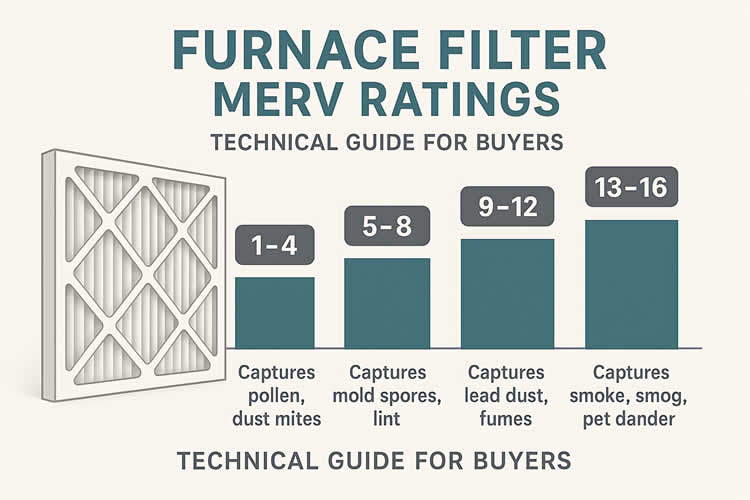
MERV (Minimum Efficiency Reporting Value) ratings range from 1 to 20 and measure a filter’s ability to capture particles of different sizes. Higher numbers capture smaller particles — but higher is not always better for residential HVAC systems, and installing the wrong MERV rating for your equipment creates problems that defeat the purpose of better filtration.
Most residential HVAC systems in the Savannah area are designed to operate with filters rated MERV-8 to MERV-11. This range captures dust, pollen, mold spores, and pet dander effectively while maintaining adequate airflow through the system. A MERV-8 filter captures approximately 70-85% of particles in the 3-10 micron range, which includes most common allergens. A MERV-11 filter pushes that capture rate above 85% and begins catching smaller particles in the 1-3 micron range.
MERV-13 filters have gained popularity because of increased awareness around indoor air quality, and they do provide noticeably better filtration — capturing bacteria, smoke particles, and very fine dust that lower-rated filters miss. However, MERV-13 filters also create significantly more airflow resistance, and many residential systems — particularly older units or systems with undersized return ductwork — cannot handle that resistance without consequences. The blower motor works harder, energy consumption increases, and in borderline cases, the restricted airflow can cause the evaporator coil to freeze.
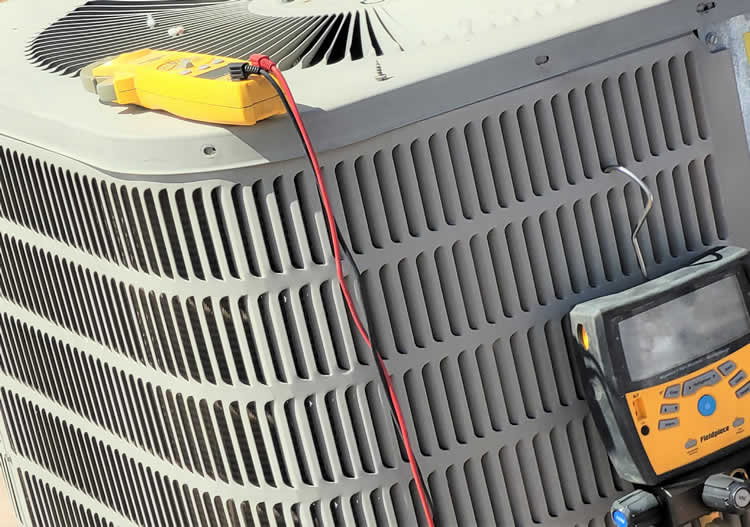
Before upgrading to MERV-13, verify that your system can handle the increased resistance. The simplest way to check is to measure the static pressure drop across the filter with the system running — something any HVAC technician can do during a maintenance visit. If the pressure drop with a MERV-13 filter exceeds the manufacturer’s recommended maximum for your air handler, drop back to MERV-11 and get better filtration through more frequent replacement rather than a denser filter.
For homes in Pooler and Savannah where allergies are a significant concern, a MERV-11 filter replaced every 30-45 days will capture more total particles over a season than a MERV-13 filter left in place for 60-90 days. The fresh MERV-11 maintains full airflow while capturing allergens effectively. The aging MERV-13, once partially loaded, restricts airflow enough to reduce the total volume of air being filtered — which means fewer particles are captured per hour even though the filter media is theoretically better.
Filter Types and What Works in This Climate
Not all filters with the same MERV rating perform equally, and the construction type matters for Savannah’s humidity conditions.
Fiberglass panel filters are the cheapest option at $1 to $3 each and are typically MERV-1 to MERV-4. They catch large debris and not much else. In Savannah’s pollen-heavy, humid environment, fiberglass filters provide insufficient protection for both air quality and equipment longevity. The only argument for them is cost, and the equipment damage from inadequate filtration costs far more than the price difference between fiberglass and pleated filters over any reasonable timeframe.
Standard pleated filters in the MERV-8 to MERV-11 range cost $8 to $20 each depending on size and brand. The pleated design provides significantly more surface area than a flat fiberglass filter, which means more filtration capacity before clogging. For most Savannah-area homes, a MERV-8 or MERV-10 pleated filter replaced every 30-60 days is the sweet spot between cost, filtration, and airflow. Buy them in multi-packs — a 6-pack of quality MERV-10 filters costs $40 to $60 and covers a full cooling season with monthly replacement.
Deep-pleated media filters (4 to 5 inches thick) are an option for homes with compatible filter cabinets. These larger filters hold significantly more dust before reaching the clogging point, extending the replacement interval to 6-12 months even in Savannah’s demanding environment. The tradeoff is a higher per-filter cost ($30 to $60 each) and the requirement for a filter cabinet that accepts the thicker media — most standard return grilles accommodate only 1-inch filters. If you are replacing your system or adding a filter cabinet, deep media filters are worth discussing with your installer because they largely solve the frequent-replacement problem.
Washable electrostatic filters cost $30 to $80 upfront and are designed to be rinsed and reused indefinitely. In theory, this eliminates replacement cost entirely. In practice, washable filters have significant drawbacks in humid climates. They must be completely dry before reinstallation — inserting a damp electrostatic filter into an air handler in Savannah’s humidity creates an ideal mold growth environment directly upstream of your evaporator coil. Thorough drying takes 24 or more hours in humid conditions, which means you either run the system without a filter while it dries or own two filters and rotate them. Most homeowners find this impractical and switch back to disposable pleated filters within a year.
The Hidden Costs of a Dirty Filter
A clogged filter does not just degrade your air quality. It triggers a cascade of mechanical and efficiency consequences that cost real money.
Energy consumption increases immediately when a filter restricts airflow. The blower motor draws more amperage to push air through the clogged media, and the system runs longer cycles because reduced airflow means reduced cooling capacity per minute of operation. Studies from the Department of Energy estimate that a dirty filter increases energy consumption by 5-15%, which translates to $15 to $45 per month during Savannah’s cooling season on a home with a $300 summer electric bill. Over a full season, that is $90 to $315 in wasted energy — far more than the cost of replacing the filter monthly.
Evaporator coil contamination accelerates when the filter fails to capture particles effectively. A clogged filter does not stop air from entering the system — it forces air to find paths around the filter edges and through gaps in the filter rack. That bypass air carries unfiltered dust, pollen, and biological material directly onto the evaporator coil surface, where it accumulates and reduces heat transfer efficiency. A professional evaporator coil cleaning costs $200 to $500 — a price that buys a lot of replacement filters.
Compressor stress from restricted airflow shortens the lifespan of the most expensive component in the system. When the evaporator coil cannot absorb enough heat due to low airflow, the refrigerant returning to the compressor is colder than designed. Over time, this can cause liquid refrigerant to reach the compressor, which damages the internal valves and bearings. A compressor replacement costs $1,200 to $2,500 — the most expensive possible consequence of a $15 filter that should have been replaced weeks earlier.
A Replacement Schedule That Works for Savannah
Based on local conditions and typical residential system configurations, here is a practical replacement schedule that accounts for Savannah’s specific environmental demands.
During peak pollen season from March through May, check the filter every two weeks and replace it when visual inspection shows significant loading. Most homes will need replacement every three to four weeks during this period. From June through October, when pollen drops but humidity and system runtime remain high, monthly replacement is the baseline for standard 1-inch pleated filters. During the winter months from November through February, when the system runs intermittently for heating and pollen counts are low, every 60-90 days is typically adequate.
These intervals assume a standard 1-inch pleated filter in the MERV-8 to MERV-11 range. Homes with pets should shorten all intervals by roughly one week per pet. Homes with ongoing construction or renovation should check filters weekly, as drywall dust and construction debris clog filters extraordinarily fast.
Set a recurring reminder on your phone rather than relying on memory. The cost of a filter is $8 to $20. The cost of forgetting is measured in hundreds of dollars of wasted energy and accelerated equipment wear.
At Carriage Heating & Cooling, we check filter condition and make specific replacement recommendations during every maintenance visit. If you are unsure which filter type or MERV rating is right for your system, ask us during your next appointment or call (912) 306-0375. We serve Pooler, Savannah, Richmond Hill, Rincon, and the surrounding area.
[IMAGE: Comparison of a clean white HVAC air filter next to a heavily clogged gray filter removed from a residential system | Alt text: Side by side comparison of a clean HVAC air filter and a dirty clogged filter showing the difference after use in a Savannah Georgia home]
=== SEO METADATA (SEOPress) === Focus Keyphrase: air filter replacement SEO Title: When to Replace Your Air Filter in Coastal Georgia (Real Answer) Meta Description: Replace your HVAC filter every 30–60 days in Savannah, not 90. Learn why coastal Georgia’s pollen and humidity demand more frequent changes and which MERV rating works. Slug: when-to-replace-air-filter-coastal-georgia Primary Category: Maintenance