What Size AC Unit Do I Need? How to Calculate for Savannah-Area Homes
Most homes in the Savannah and Pooler area need a 2.5 to 4-ton AC system, with the specific size determined by a Manual J load calculation that accounts for your home’s square footage, insulation, window area, ceiling height, ductwork, and — critically in this market — the extreme humidity load that coastal Georgia imposes on cooling equipment. A rough starting estimate is one ton of cooling per 500 to 600 square feet, but that rule of thumb is dangerously imprecise in a climate where humidity management is half the system’s job, and using it instead of a proper calculation is the most common reason homes in this area end up with equipment that either cannot keep up or short-cycles and leaves the house feeling clammy.
Getting the size right matters more than brand, more than efficiency rating, and more than any feature on the spec sheet. An oversized system wastes energy, fails to dehumidify, and wears out prematurely. An undersized system runs constantly without reaching setpoint on the hottest days. Both mistakes lock you into 15 years of compromised comfort and inflated operating costs. The sizing calculation is the foundation everything else is built on, and cutting corners on it is the most expensive mistake in residential HVAC.
Why Square Footage Alone Gets It Wrong
The “one ton per 500 square feet” guideline circulates widely online, and it is close enough to be dangerous. It produces a ballpark number that works reasonably well for a moderately insulated home in a moderate climate with average window area and standard ceiling heights. Savannah is not a moderate climate, and homes in this market vary wildly in the factors that determine cooling load.
A 2,000-square-foot home in Pooler’s newer subdivisions — built after 2010 with modern insulation, low-E windows, and sealed ductwork — might need 3 tons of cooling. A 2,000-square-foot home in Savannah’s historic Ardsley Park neighborhood — built in the 1920s with minimal wall insulation, single-pane windows, and an HVAC system retrofitted into a house that was never designed for central air — might need 4 tons to handle the same outdoor conditions. Same square footage, a full ton of difference, because the older home gains heat from the outdoors at a dramatically faster rate.
Ceiling height alone can shift the calculation by half a ton. Standard 8-foot ceilings contain roughly 16,000 cubic feet of air in a 2,000-square-foot home. The 10-foot ceilings common in Savannah’s Victorian-era homes and in many newer Pooler builds increase that volume to 20,000 cubic feet — 25% more air that the system must cool and dehumidify. The 12-foot ceilings in some downtown Savannah residences push the volume even higher. Every cubic foot of additional air volume adds to the cooling load.
Window area and orientation have an outsized impact in the Savannah market. South and west-facing windows receive the most direct solar radiation during the afternoon hours when outdoor temperatures peak. A home with a large west-facing great room wall of windows can gain 3,000 to 5,000 BTU per hour through solar radiation alone during a July afternoon — the equivalent of running a space heater in the room. Low-E coated double-pane windows cut that solar gain by 40-60% compared to older single-pane glass, which is why window type matters as much as window area in the calculation.
What a Manual J Load Calculation Actually Measures
Manual J is the industry-standard method for calculating residential cooling and heating loads, published by the Air Conditioning Contractors of America (ACCA). It is not a rough estimate or a formula on the back of a napkin — it is a room-by-room engineering calculation that produces a specific BTU load number for your home, which directly translates to the tonnage requirement.
The inputs to a Manual J calculation include every factor that affects how quickly your home gains heat from the outdoors and how much internal heat the system must also manage. Square footage and cubic volume of conditioned space is the starting point but only the starting point. Wall construction and insulation R-values determine how fast heat conducts through the building envelope. Roof and attic insulation R-values are particularly important in Savannah, where attic temperatures regularly exceed 140°F in summer and a poorly insulated ceiling transmits enormous heat into the living space below.
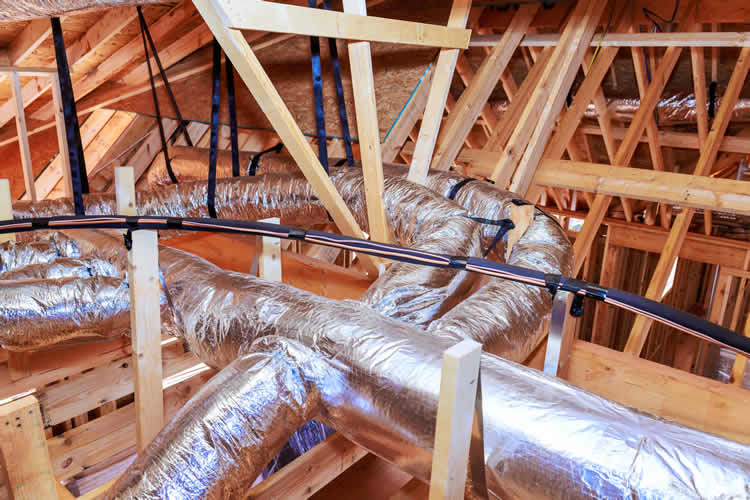
Window specifications — size, type, glass coating, frame material, and compass orientation for each window — account for both conductive heat gain through the glass and solar radiation gain through sunlight. The number of exterior doors and their insulation value are factored in. Duct location and condition matter because ductwork in an unconditioned attic loses a percentage of its cooling capacity to the surrounding heat, which means the system must be sized to overcome both the building load and the duct losses.
Infiltration — air leakage through gaps in the building envelope — adds to the cooling load. Older homes in Savannah’s historic districts, where original plaster walls, century-old window frames, and unweatherstripped doors allow significant air exchange with the outdoors, have infiltration rates several times higher than modern construction. This air leakage brings both heat and humidity into the home, and both must be accounted for in the sizing calculation.
The occupant load accounts for heat generated by the people living in the home (each person produces roughly 250 to 400 BTU per hour of sensible and latent heat), plus heat from lighting, cooking appliances, and electronics. A home office with multiple monitors and a gaming PC generates meaningful internal heat that shifts the load calculation.
Finally — and this is where Savannah’s climate makes the calculation unique — the latent load from humidity must be quantified separately from the sensible (temperature) load. In dry climates, the latent load is a small fraction of the total, and sizing for temperature alone gets close enough. In Savannah, where outdoor dew points routinely hit 72°F to 76°F during summer, the latent load can represent 25-35% of the total cooling requirement. A calculation that ignores or underestimates the latent load will produce a system that controls temperature but fails at humidity management — the most common comfort complaint in this market.
The Savannah Humidity Problem and How It Affects Sizing
Savannah’s design conditions for HVAC sizing use approximately 95°F dry bulb temperature and 77°F wet bulb temperature. That wet bulb number captures the humidity component, and it is significantly higher than the wet bulb design temperatures used in cities like Atlanta (74°F), Dallas (75°F), or Phoenix (70°F). The higher wet bulb temperature means more of the system’s capacity must be dedicated to removing moisture from the air rather than simply lowering the temperature.
This has a direct and counterintuitive impact on equipment selection. In a dry climate, you could oversize a system by half a ton without major consequences — it would cool slightly faster and cycle slightly more often, but the comfort impact would be minimal. In Savannah, that same half-ton of oversizing creates a system that reaches the temperature setpoint too quickly, shuts off before the evaporator coil has run long enough to wring sufficient moisture from the air, and leaves the home at 72°F but 60% relative humidity. The thermostat says the house is cool. Your skin says otherwise. You feel sticky, the windows fog, and the mold risk on interior surfaces climbs.
This is why experienced HVAC contractors in the coastal Georgia market sometimes deliberately size systems at the lower end of the Manual J range rather than the upper end. A system that is fractionally undersized runs longer cycles, which pulls more moisture from the air per cycle and delivers better humidity control. The tradeoff is that on the absolute hottest afternoons — a handful of days per year when temperatures hit 98°F or above — the system may not quite reach the thermostat setpoint for a few hours. Most homeowners find that tradeoff acceptable because the humidity comfort improvement is noticeable every day of the cooling season, while the temperature shortfall happens rarely and amounts to a degree or two.
Common Sizes for Savannah-Area Homes
While every home requires its own calculation, general patterns in the local housing stock provide useful reference points for evaluating whether a contractor’s recommendation is in the right range.
Condominiums and small single-story homes in the 800 to 1,200 square foot range typically need 1.5 to 2 tons. This size is common in apartment conversions, carriage houses in the historic district, and smaller patio homes.
Mid-size homes in the 1,200 to 1,800 square foot range — typical of older ranch homes in Savannah and starter homes in Pooler — generally need 2.5 to 3 tons. Insulation quality is the biggest variable in this range. A well-insulated 1,800-square-foot home might get by with 2.5 tons, while a poorly insulated one of the same size needs 3.
The 1,800 to 2,500 square foot range covers the bulk of newer construction in Pooler, Richmond Hill, and Savannah’s suburban neighborhoods. These homes typically need 3 to 3.5 tons. Two-story homes in this range may benefit from a zoned system or two separate systems — one for each floor — since heat rises and the second floor carries a disproportionate cooling load relative to its square footage.
Larger homes in the 2,500 to 3,500 square foot range need 3.5 to 5 tons. Homes at the upper end of this range, particularly two-story designs with high ceilings, large window areas, or poorly insulated bonus rooms over garages, may exceed the 5-ton threshold and require either a single large-capacity system or two smaller systems serving different zones.
Any contractor who quotes a system size without visiting your home and performing some form of load assessment — whether a full Manual J calculation or at minimum a detailed evaluation of the factors described above — is guessing. And guessing on a purchase you will live with for 15 years is not a risk worth taking to save an hour of assessment time.
What Happens When the Size Is Wrong
The consequences of incorrect sizing are not hypothetical. They are specific, measurable, and persistent for the life of the equipment.
An oversized system short-cycles — turning on and off in rapid succession rather than running steady, extended cycles. Each startup draws a surge of electricity that is significantly higher than steady-state running consumption, so a system that cycles 8 times per hour uses more energy than one that cycles 3 to 4 times per hour despite running fewer total minutes. Short-cycling also causes accelerated wear on the compressor and contactor, both of which have finite cycle-life ratings. A compressor rated for 50,000 cycles at 4 cycles per hour reaches that limit in about 7 years of Savannah cooling-season operation. At 8 cycles per hour, it reaches the same limit in roughly 3.5 years.
The humidity failure of an oversized system in Savannah creates secondary problems beyond discomfort. Indoor relative humidity consistently above 55% promotes mold growth on walls, in closets, on window frames, and inside ductwork. It accelerates deterioration of wood trim and hardwood floors. It creates a hospitable environment for dust mites, which are a primary trigger for indoor allergies. And it makes the air feel warmer than the thermostat reading, which leads homeowners to lower the setpoint further, running the oversized system even more aggressively and compounding the short-cycling problem.
An undersized system runs at or near maximum capacity for extended periods during peak summer conditions. While long run times improve dehumidification, the continuous operation stresses the compressor, drives up energy bills, and may still fail to reach setpoint during the hottest hours of the day. An undersized system in Savannah’s July heat may maintain 76°F when the thermostat is set to 72°F — tolerable but not what you paid for.
How to Verify Your Contractor’s Sizing Recommendation
You do not need to perform the Manual J calculation yourself, but you should verify that your contractor actually performed one rather than estimating from square footage.
Ask to see the calculation output. A Manual J calculation performed with industry software (Wrightsoft, HVAC-Calc, or CoolCalc are the most common) produces a printed or digital report showing the inputs used and the resulting load in BTU. If the contractor cannot produce this report, the sizing was not calculated — it was estimated.
Cross-reference the recommended tonnage against the general ranges for your home’s size and condition described above. If the recommendation falls outside those ranges, ask the contractor to explain what specific factor in your home drives the unusual sizing. There may be a perfectly legitimate reason — a sunroom with floor-to-ceiling south-facing glass, an uninsulated cathedral ceiling, or extensive ductwork in a superheated attic. But the contractor should be able to articulate that reason clearly.
Be wary of a contractor who recommends a significantly larger system than your current one without explaining what changed. If your home was adequately cooled by a 3-ton system for the past 15 years, a recommendation to install a 4-ton replacement needs justification beyond “bigger is better.” The home’s insulation, windows, and ductwork have not changed — and if anything, building envelope improvements you have made over the years should reduce the required tonnage, not increase it.
Getting It Right the First Time
At Carriage Heating & Cooling, every system replacement begins with a Manual J load calculation specific to your home. We measure, we calculate, and we size based on the results — not rules of thumb, not the size of whatever system was installed before, and not the largest system the ductwork can handle. If the calculation shows your home needs 3 tons, we install 3 tons regardless of whether you are hoping for 4.
Call (912) 306-0375 for a free sizing assessment and replacement estimate anywhere in Pooler, Savannah, Richmond Hill, or the surrounding area.