What Is a Ductless Mini-Split? How It Works in Plain English
A ductless mini-split is an air conditioning and heating system that cools or heats individual rooms without using ductwork. It consists of a small outdoor compressor unit connected to one or more indoor units by a thin refrigerant line that passes through a 3-inch hole in the wall — no attic ductwork, no large air handler, no vents in the floor or ceiling.
Each indoor unit controls the temperature in its own room independently, which means you can keep the bedroom at 68°F while the living room sits at 74°F, or turn off cooling entirely in rooms nobody is using. Installed cost in the Savannah area runs $3,000 to $5,500 for a single room and $8,000 to $15,000 for a whole-home multi-zone system.
If you have lived in Savannah for any length of time, you have probably seen these units without knowing what they were — the slim white rectangles mounted high on the wall in restaurants, yoga studios, sunrooms, and garage apartments. They have been standard technology in Asia and Europe for decades but only gained mainstream traction in the U.S. residential market within the past 15 years.
In Savannah’s housing landscape — where thousands of pre-war homes lack ductwork, where bonus rooms and garage conversions are perpetually uncomfortable, and where humidity management matters as much as temperature control — mini-splits solve problems that conventional HVAC systems either cannot address or address only with expensive ductwork retrofits.
This article explains how the technology works, what the components are, who it is for, and what it costs to own — written for homeowners who want to understand the system before they start collecting quotes.
The Basic Concept: Moving Heat Instead of Making It
Every air conditioning system works on the same principle: it does not create cold air. It moves heat from one place to another. Your refrigerator does this — it pulls heat from inside the insulated box and dumps it out the back into your kitchen. A central air conditioning system does the same thing at house scale — it pulls heat from inside your home and dumps it outside through the condenser unit sitting in your yard.
A mini-split works identically. The only difference is how the cooled air gets delivered to the rooms. A central system uses a large air handler and a network of ducts to push cooled air through vents throughout the house. A mini-split skips the ducts entirely and puts a small, self-contained air delivery unit directly in each room that needs conditioning.
That distinction — ducted versus ductless delivery — is the entire difference. The refrigeration technology, the compressor mechanics, and the thermodynamic principles are the same. Understanding this helps cut through the marketing confusion: a mini-split is not exotic or experimental technology. It is a conventional refrigeration system with a different (and in many situations, better) method of getting the conditioned air to where you actually live.
The Components: What You Are Actually Installing
A mini-split system has two main components and a few connecting parts. Here is what each one is and what it does.
The outdoor unit looks like a smaller version of the condenser you see beside any home with central air — a metal box with a fan and a coil, sitting on a pad or mounted to a wall bracket. This unit contains the compressor, which is the motor that drives the entire refrigeration cycle.
In cooling mode, the outdoor unit receives hot refrigerant gas from the indoor unit, compresses it into a high-pressure state, passes it through the outdoor coil where the fan blows ambient air across it to remove the heat, and sends the now-cooled liquid refrigerant back inside to absorb more heat. In heating mode (all mini-splits sold today are heat pumps), the cycle reverses — the outdoor unit extracts heat from the outdoor air and sends it inside.
The outdoor unit for a single-zone system is compact — roughly 30 to 35 inches wide and 23 to 27 inches tall, significantly smaller than a conventional central AC condenser. Multi-zone outdoor units that serve two to five indoor units are larger but still smaller than a typical central condenser. The reduced size matters in Savannah, where side yards are narrow, historic lots are compact, and exterior aesthetics affect both property values and, in the Historic District, regulatory approval.
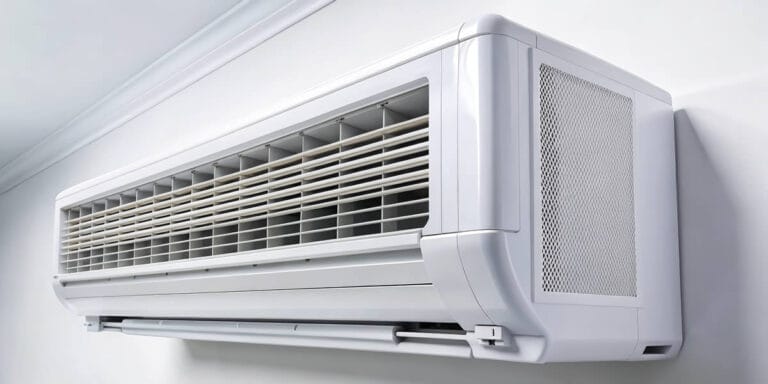
The indoor unit is the component that sits inside the room being conditioned. It contains the evaporator coil (where the refrigerant absorbs heat from the room air), a blower fan (which circulates air across the coil and back into the room), air filters (which capture dust and particulates before they reach the coil), and a drain pan (which collects the condensation produced when warm, humid air contacts the cold coil surface).
Indoor units come in several form factors. The wall-mounted unit is the most common in residential installations — it mounts on a bracket near the ceiling on any interior or exterior wall, measures roughly 32 inches wide by 12 inches tall by 9 inches deep, and distributes conditioned air through adjustable louvers that direct airflow downward and across the room.
Ceiling cassettes mount flush with the ceiling and blow air in two or four directions. Floor-standing consoles sit at baseboard level. Concealed ducted units hide inside a ceiling cavity or closet and distribute air through short duct runs to one or two rooms. Each form factor serves a different use case, but wall-mounted units account for the vast majority of residential installations because they are the least expensive, easiest to install, and simplest to maintain.
The line set is the connection between the outdoor and indoor units — two insulated copper refrigerant tubes, a condensate drain hose, and a communication cable bundled together and routed through a 3-inch hole in an exterior wall. That 3-inch hole is the total structural modification required for a standard installation. Compare this to the 12-by-12-inch or larger duct penetrations that conventional systems require at every supply and return location, and the installation simplicity of mini-splits becomes clear.
The condensate drain carries water from the indoor unit to the exterior of the home. In Savannah’s climate, this drain handles serious volume — one to three gallons per day per unit during peak summer — because the system is constantly dehumidifying the humid indoor air.
The drain typically exits through the same wall penetration as the line set and drips onto the ground outside. Proper drain routing with adequate slope is essential because any standing water in the drain line becomes a biological growth site in Savannah’s heat, leading to clogs that can cause the indoor unit to leak.
The Inverter Compressor: Why Mini-Splits Feel Different
The technology that makes mini-splits feel noticeably different from conventional air conditioning is the inverter-driven compressor — and understanding this one component explains most of the advantages homeowners experience.
A conventional central air conditioner has a compressor that runs at one speed: full blast. When the thermostat calls for cooling, the compressor kicks on at 100% capacity, runs until the thermostat is satisfied, then shuts off completely. This on-off cycling creates temperature swings — the room cools to 71°F, the system shuts off, the room warms to 74°F before the thermostat calls again, and the compressor fires back up. You feel this as alternating periods of cool air blowing from the vents and warm, still air when the system is between cycles.
A mini-split’s inverter compressor adjusts its speed continuously to match the current cooling demand. When the room is far from the setpoint — you just got home and the house is 82°F — the compressor ramps up to high output to cool quickly. As the room approaches the setpoint, the compressor slows down gradually. Once the setpoint is reached, the compressor does not shut off. It continues running at very low output, just enough to offset the heat leaking in through walls, windows, and infiltration, maintaining the room temperature within a degree of the setpoint without ever cycling off.
The practical result is steady, consistent comfort. The room stays at 72°F, not oscillating between 71°F and 74°F. Air flows from the indoor unit continuously at a gentle, quiet rate rather than alternating between a blast and silence. And because the compressor runs at partial capacity most of the time rather than cycling at full capacity, it uses significantly less electricity — the same way driving 55 mph on cruise control uses less gas than repeatedly accelerating to 70 and braking to 40.
For Savannah homeowners, the inverter’s continuous operation has a second benefit that matters as much as temperature consistency: superior dehumidification. The evaporator coil inside the indoor unit stays cold continuously rather than warming up between cycles.
A warm coil between cycles allows moisture that has condensed on its surface to re-evaporate back into the room air — effectively undoing some of the dehumidification that occurred during the previous run cycle. A coil that stays cold continuously keeps condensing moisture without interruption, pulling far more water from the air per hour than an equivalent-capacity conventional system that cycles on and off.
In a climate where outdoor dew points routinely exceed 72°F for six months of the year, this continuous dehumidification is transformative. Mini-split owners in Savannah consistently report that the humidity improvement is more dramatic than the temperature improvement — the house does not just feel cooler, it feels drier, lighter, and fundamentally more comfortable.
Zone Control: Cooling What You Use, Ignoring What You Don’t
A central air system conditions the entire house to one temperature. The thermostat in the hallway governs every room, regardless of which rooms are occupied. You cannot meaningfully control individual rooms without installing an aftermarket zoning system (expensive) or closing vents (which causes airflow problems the system was not designed for).
A mini-split system is zoned by default. Each indoor unit has its own thermostat — either a remote control, a wall-mounted controller, or a smart-home integration — and operates independently. This architecture creates two categories of value.
The first is comfort customization. The person who sleeps best at 66°F can run their bedroom unit colder without freezing everyone in the living room. The home office can be kept comfortable during work hours and turned off at 5 PM. The guest room stays off until guests arrive.
Different rooms with different heat loads — the west-facing sunroom that bakes in the afternoon versus the shaded north-facing bedroom — can each be maintained at comfortable temperatures simultaneously rather than averaging out to a compromise that satisfies nobody.
The second is energy savings. A three-person household occupying the living room and kitchen during the day, then moving to the bedrooms at night, might actively condition 800 square feet at any given time rather than the full 2,000-square-foot home.
The mini-split units serving unoccupied rooms either run at minimum output or shut off entirely. This selective cooling reduces energy consumption by 20-40% compared to a central system cooling the entire house continuously — a savings that shows up on the electric bill every month of Savannah’s seven-month cooling season.
What Mini-Splits Do Especially Well in Savannah
Several characteristics of Savannah’s climate and housing stock align particularly well with mini-split strengths.
Humidity management in shoulder seasons is where mini-splits outperform central air most dramatically. During March, April, October, and November, Savannah regularly delivers days where the temperature is comfortable (70s to low 80s) but the humidity is oppressive (65-80% relative humidity).
A central air system cannot dehumidify without also cooling, so homeowners face a choice between overcooling the house to manage humidity or turning the system off and accepting clammy indoor conditions.
Every mini-split has a dedicated “dry” mode that runs the compressor at low capacity and the fan at minimum speed, prioritizing moisture removal over temperature reduction. The system dehumidifies the room without driving the temperature down below comfortable levels. This mode uses roughly half the energy of full cooling mode and prevents the indoor humidity spikes that cause mold growth, musty odors, and the general feeling of heaviness that Savannah homeowners know intimately during the transitional months.
Homes without ductwork represent a substantial segment of Savannah’s housing market. The historic district alone contains thousands of homes built before air conditioning existed, and the surrounding neighborhoods — Ardsley Park, Thomas Square, Parkside, Starland, Baldwin Park, Midtown — add thousands more. Mini-splits provide the only practical path to whole-home cooling in many of these structures without the cost and disruption of a major ductwork retrofit.
A four-zone mini-split system can condition an entire 1920s bungalow for $10,000 to $13,000 installed, compared to $15,000 to $25,000 for a conventional duct retrofit or a high-velocity system — and the mini-split installation takes one to two days versus a week or more for ductwork.
Supplemental cooling for problem areas is the most common entry point for mini-splits in homes that already have central air. The bonus room over the garage that the central system cannot keep below 80°F in July. The master bedroom addition that was added after the original HVAC was sized.
The enclosed porch that was converted to a sunroom but never connected to the duct system. The home office in a converted garage. These are rooms where a single-zone mini-split at $3,000 to $5,000 solves a specific, persistent comfort problem that no amount of duct balancing or thermostat adjustment can fix, because the root issue is that the space was never part of the original cooling design.
What Mini-Splits Do Not Do Well
Honest evaluation requires acknowledging where mini-splits are not the best choice.
Whole-home air filtration is limited compared to a central system with a full-size media filter. Mini-split filters are basic mesh screens that capture large particles but do not approach the MERV-11 or MERV-13 filtration available in central systems. For households with significant allergy or respiratory concerns, a central system with enhanced filtration or a standalone HEPA air purifier in key rooms is more effective at particle-level air cleaning.
Aesthetics are a legitimate concern. A wall-mounted mini-split unit is visible. In a carefully designed living room, a bedroom with a minimalist aesthetic, or a historic parlor with period-appropriate details, the unit is a visual compromise that some homeowners accept and others do not. Ceiling cassettes and concealed ducted units mitigate this concern but add cost and installation complexity.
Maintenance responsibility falls more directly on the homeowner than with central systems. The washable filters need cleaning every two to four weeks — a two-minute task that many owners neglect until the unit develops mold on the blower wheel and starts producing musty air.
The condensate drain needs quarterly attention. And the annual professional deep cleaning that Savannah’s humidity demands adds a recurring service cost of $150 to $300 per indoor unit. None of this is burdensome, but it is more hands-on than a central system where the homeowner’s only task is swapping a disposable filter every 30 to 60 days.
Multi-zone systems have a capacity sharing limitation. A single outdoor condenser serving five indoor units distributes its total output across those units based on demand. During peak load conditions — a July afternoon when every room is fighting 95-degree heat simultaneously — the system may not deliver full rated capacity to every room at the same time. Experienced installers account for this in the design phase, but it is a real-world limitation that homeowners should understand.
Cost of Ownership: The Complete Picture
The total cost of owning a mini-split system over its 15 to 20-year lifespan includes installation, operating energy, and maintenance.
Installation cost ranges from $3,000 to $5,500 for a single zone to $8,000 to $15,000 for a multi-zone whole-home system. Equipment brand, indoor unit type, line set routing complexity, and electrical panel capacity are the primary cost variables.
Operating cost in the Savannah market runs approximately $25 to $50 per month per zone during peak cooling season, with lower costs during shoulder months and heating season. A four-zone system cooling a whole home costs roughly $105 to $130 per month during peak summer — approximately 20-30% less than a central system cooling the same square footage, primarily due to inverter efficiency and zone control savings.
Maintenance cost includes $150 to $300 per indoor unit annually for professional deep cleaning (essential in Savannah’s humidity), plus the homeowner’s time for biweekly filter cleaning and quarterly drain line treatment. Over 15 years, total maintenance cost runs $2,500 to $5,000 per indoor unit — more than a central system’s maintenance cost per zone, but offset by the lower operating cost.
Total cost of ownership over 15 years for a four-zone system, including installation, energy, and maintenance, is comparable to a central system of equivalent capacity. The mini-split’s higher maintenance cost and higher installation cost (in some configurations) are roughly offset by its lower operating cost and superior humidity management, which reduces secondary costs like mold remediation and elevated dehumidifier usage that Savannah homeowners with conventional systems sometimes incur.
Is a Mini-Split Right for Your Situation?
The answer depends on your specific home and what problem you are solving.
If your home has no ductwork and you need cooling, a mini-split is almost certainly your best option. The alternatives — ductwork retrofit, high-velocity system, or window units — are either more expensive, more disruptive, or dramatically less effective.
If your home has central air but specific rooms are consistently uncomfortable, a single-zone mini-split supplements the existing system at a fraction of the cost of re-engineering the ductwork.
If you are building a new addition, converting a garage, or enclosing a porch, a mini-split conditions the new space without oversizing your existing central system or running new ductwork from the existing air handler.
If you are replacing a whole-home system and your ductwork is in poor condition — leaky, uninsulated, sagging in the attic — a multi-zone mini-split eliminates the duct losses entirely rather than spending $3,000 to $5,000 on duct repair followed by a conventional system that still loses 15-20% of its output through the repaired ducts.
At Carriage Heating & Cooling, we install both ductless mini-splits and conventional central systems and recommend based on what your home actually needs.
We work with Mitsubishi, Fujitsu, Daikin, and other major manufacturers and provide free site assessments that evaluate your home’s specific conditions — construction type, room layout, existing electrical service, and the problem you are trying to solve. Call (912) 306-0375 for a consultation anywhere in Pooler, Savannah, Richmond Hill, Tybee Island, or the surrounding area.