Should I Repair or Replace My AC? The Savannah Homeowner’s Decision Guide
If your AC repair costs more than 50% of what a new system would cost and your current equipment is over 10 years old, replacing it is almost always the better financial decision. For most Savannah-area homeowners, that tipping point falls somewhere between $1,500 and $2,500 in repair costs on a system that is 10 to 15 years old — though several other factors including refrigerant type, efficiency loss, and repair frequency should weigh into the final call.
This is the most expensive question in home comfort, and it deserves a more honest answer than “it depends.” The HVAC industry has a reputation for pushing replacements when repairs would suffice and pushing repairs when replacement is the smarter long-term move — depending on which generates more revenue for the company standing in your living room. The math is not actually that complicated once you know what to look at. Here is how to make the decision with confidence.
The 50% Rule and Why It Needs Context
The most widely cited guideline in the industry is the 50% rule: if a repair costs more than half the price of a new system, replace it. This is a reasonable starting point, but applying it blindly leads to bad decisions in both directions.
A new AC system installed in the Savannah and Pooler market typically costs between $5,000 and $12,000 depending on system type, size, efficiency rating, and whether ductwork modifications are needed. That means the 50% threshold sits between $2,500 and $6,000 — a range so wide it is almost useless without additional context.
The rule works best when combined with system age. A $2,000 compressor repair on a 4-year-old system that is otherwise in excellent condition is almost certainly worth doing, even though it technically hits that 50% mark on a lower-end system. That same $2,000 repair on a 13-year-old system running R-22 refrigerant is almost certainly not worth it, because you are investing heavily in equipment that is approaching end-of-life and running on a refrigerant that gets more expensive every year.
The Age Factor: What the Numbers Actually Say
The average lifespan of a central AC system in the southeastern United States is 12 to 17 years, according to data from the Department of Energy and major manufacturer guidelines. But that national average obscures a regional reality: systems in Savannah work significantly harder than systems in cooler, drier climates, and harder work means shorter lifespans.
Your AC in Pooler or Savannah runs six to seven months per year as a primary cooling system — roughly April through October — compared to four or five months in the mid-Atlantic or upper South. During July and August, it may run 14 to 18 hours per day when outdoor temperatures hit the mid-90s and humidity pushes the heat index past 105°F. That cumulative runtime adds up. A system in Savannah at 12 years old has racked up the equivalent operating hours of a 15 or 16-year-old system in Nashville or Raleigh.
This does not mean every 12-year-old system in Savannah needs replacing. It means that when you are evaluating a major repair on a system in that age range, you should mentally adjust your expectations downward for remaining useful life. A 12-year-old system here likely has 3 to 5 years left under ideal conditions — and “ideal conditions” means consistent preventive maintenance, no major component failures, and no refrigerant issues.
The Refrigerant Question Is a Dealbreaker
If your system uses R-22 (commonly called Freon), this single factor can shift the entire repair-vs-replace equation. R-22 was phased out of production in the United States in January 2020 under the Clean Air Act. No new R-22 is being manufactured, and the only available supply comes from reclaimed stockpiles and recovered refrigerant from decommissioned systems.
The practical impact is straightforward: R-22 prices have climbed from roughly $30 per pound a decade ago to $80 to $150 per pound today, and the trajectory is only going up. If your system needs a refrigerant recharge — which usually indicates a leak somewhere in the system — you are paying premium prices to fill a system that will likely need refilling again within 12 to 24 months unless the leak is also repaired.
Repairing the leak and recharging with R-22 on a system that is already 12 or more years old frequently costs $800 to $1,500. That money buys you a couple more years on equipment that was already aging. Putting that same $800 to $1,500 toward a down payment on a new system running R-410A or the newer R-454B gives you 15 or more years of reliable operation with inexpensive, readily available refrigerant. The math is not close.
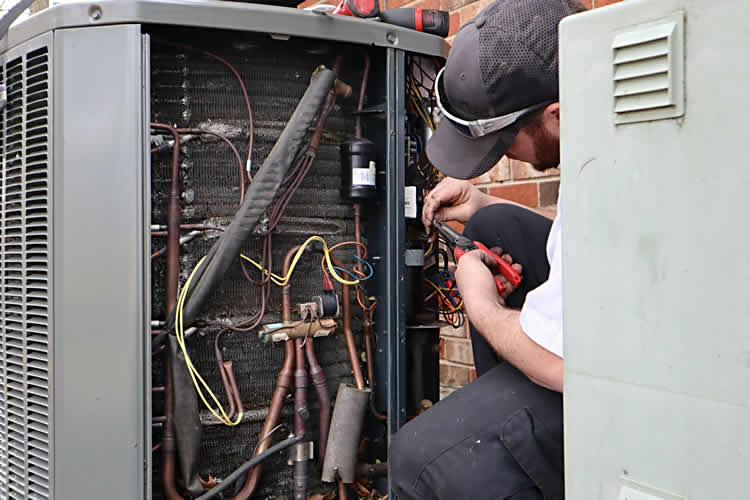
If you are unsure which refrigerant your system uses, check the data plate on your outdoor condenser unit. It is a metal label — usually on the side panel — that lists the model number, serial number, and refrigerant type.
The Efficiency Gap: What You Are Losing Every Month
Older systems lose efficiency gradually, and the loss is invisible on any single energy bill but adds up substantially over years. A system installed in 2010 was likely rated at 13 SEER (Seasonal Energy Efficiency Ratio). After 14 years of operation in Savannah’s demanding climate, that system is probably performing closer to 10 or 11 SEER due to normal wear on the compressor, coils, and blower motor.
New systems sold in 2025 must meet a minimum of 15 SEER2 under the updated Department of Energy efficiency standards that took effect in January 2023 for the Southeast region. Mid-range systems typically land at 16 to 18 SEER2, and high-efficiency units reach 20 SEER2 or higher.
The difference in monthly operating cost between a degraded 10-11 SEER system and a new 16 SEER2 system is roughly $40 to $80 per month during the cooling season in a typical 2,000-square-foot Savannah-area home. Over a six-to-seven-month cooling season, that translates to $240 to $560 per year in energy savings. Over the 15-year lifespan of the new system, those savings compound to $3,600 to $8,400 — a number that dramatically changes the replacement calculus.
This does not mean efficiency savings alone justify a new system. But when you combine those savings with the avoided cost of future repairs on aging equipment, the total cost of ownership almost always favors replacement once a system crosses the 12-year mark and needs a repair exceeding $1,000.
The Repair Frequency Test
A single expensive repair on an otherwise healthy system is not necessarily a reason to replace. Repeated repairs are.
If you have called an HVAC technician more than twice in the last 18 months for non-maintenance issues, your system is telling you something. Component failures tend to cascade in aging equipment — a failing compressor puts extra strain on electrical components, a dirty evaporator coil forces the blower motor to work harder, and degraded refrigerant lines cause the whole system to run less efficiently, which accelerates wear on everything else.
Track your repair spending over a rolling 24-month window. If total repair costs in that period exceed $1,000 on a system over 10 years old, you have crossed the threshold where continued repairs represent poor return on investment. You are not maintaining a system at that point — you are financing its slow failure one service call at a time.
The Comfort Factor That Spreadsheets Miss
Financial analysis captures most of the repair-vs-replace decision, but it misses one thing that Savannah homeowners understand viscerally: the cost of being without AC in August.
An older system that fails on a 97°F day with 80% humidity does not just create an inconvenience. It creates a situation that is genuinely dangerous for elderly family members, young children, and pets within hours. And the timeline to get a new system installed — especially during peak summer demand — is typically 3 to 7 business days, not 24 hours. Emergency repair on an existing system is usually faster, but if the failure is catastrophic (a dead compressor, a seized blower motor), you may be waiting for parts regardless.
Proactive replacement during the shoulder seasons — March, April, October, or November — gives you scheduling flexibility, lower demand pricing from some contractors, and zero risk of being caught without cooling when it matters most. There is no spreadsheet cell for the misery of three days without AC in a Savannah summer, but anyone who has lived through it understands it has a cost.
A Decision Framework That Actually Works
Rather than relying on a single rule, run through these five questions in order. If you answer “yes” to three or more, replacement is likely the stronger financial decision.
Is the system more than 10 years old? Does it use R-22 refrigerant? Is the current repair estimate above $1,500? Have you spent more than $1,000 on repairs in the past 24 months? Have your summer energy bills increased more than 20% over the past three years with no change in usage patterns?
Three or more “yes” answers point strongly toward replacement. Two “yes” answers put you in a gray zone where the specific repair matters — a $400 capacitor replacement is worth doing on a 12-year-old system, while a $2,000 coil replacement on that same system is harder to justify. One or zero “yes” answers means the repair is probably the right call.
What a Trustworthy Technician Should Tell You
Any HVAC professional worth hiring should be willing to give you an honest assessment of whether a repair makes sense — even when that assessment costs them a sale. At Carriage Heating & Cooling, we walk homeowners through the math using their specific system age, repair history, and energy costs. If a repair is the right move, we say so. If replacement makes more sense, we explain exactly why and provide options at multiple price points so the decision stays in your hands.
If you are sitting on a repair quote and not sure whether it is worth the money, call us at (912) 306-0375. We provide second opinions across Pooler, Savannah, Richmond Hill, and the surrounding area, and we will give you an honest answer whether it leads to a repair invoice or a replacement proposal.