MERV Ratings Explained: Which Air Filter Actually Works for Your Home?
For most homes in the Savannah and Pooler area, a MERV-10 or MERV-11 pleated filter replaced every 30 to 45 days is the best balance of allergen capture, airflow compatibility, and cost. MERV-8 works adequately for households without allergy concerns but misses smaller particles that matter in a high-pollen, high-humidity climate.
MERV-13 provides superior filtration but creates airflow restriction that many residential systems cannot handle without consequences — reduced efficiency, frozen coils, and accelerated blower motor wear. The right MERV rating is not the highest number you can buy. It is the highest number your specific system can tolerate without choking.
MERV stands for Minimum Efficiency Reporting Value, and it is the industry-standard scale for measuring how effectively an air filter captures particles of different sizes. The scale runs from 1 to 20, with higher numbers capturing smaller particles at higher rates.
It was developed by ASHRAE (the American Society of Heating, Refrigerating and Air-Conditioning Engineers) to give consumers a standardized way to compare filters across brands and types — because without it, marketing terms like “high performance,” “allergen defense,” and “maximum filtration” mean whatever the manufacturer wants them to mean.
Understanding the scale takes five minutes. Getting the wrong filter costs you months of degraded comfort, wasted energy, and potentially damaged equipment. Here is what the numbers actually mean and how to choose the right one for your home in coastal Georgia.
What the Numbers Mean: A Practical Breakdown
MERV ratings measure a filter’s ability to capture particles across three size ranges: 0.3 to 1.0 microns (the smallest), 1.0 to 3.0 microns (mid-range), and 3.0 to 10.0 microns (the largest). For reference, a human hair is roughly 70 microns in diameter. A grain of pollen is 10 to 100 microns. A mold spore is 3 to 30 microns. Dust mite allergen particles are 1 to 10 microns. Bacteria range from 0.3 to 10 microns. The particles that matter most for indoor air quality in Savannah — pollen, mold spores, and dust mite allergens — fall primarily in the 1 to 10 micron range.
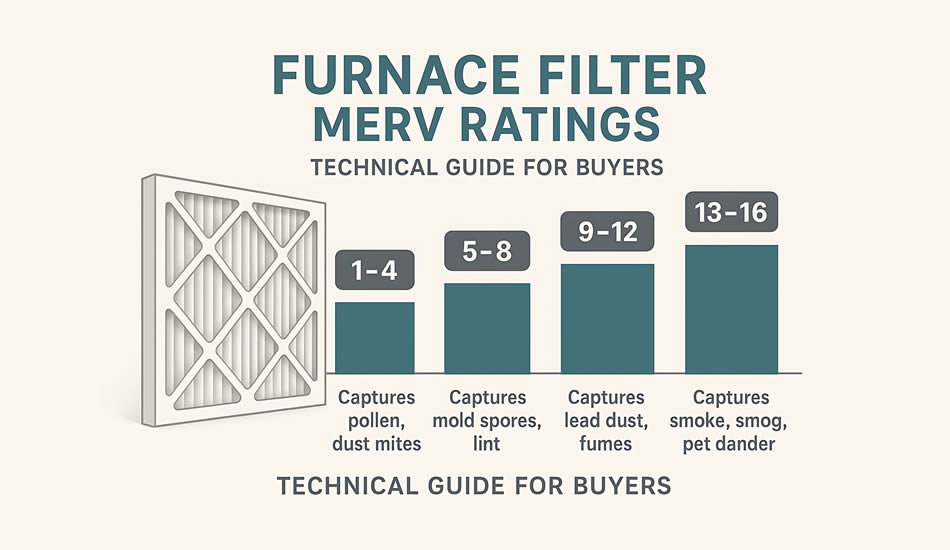
MERV 1 through 4 represents the bottom tier. These are the flat fiberglass panel filters that cost $1 to $3 at the hardware store — the translucent blue or white pads that look like they belong in a shop fan. They capture large debris like lint, carpet fibers, and dust bunnies, but they let the vast majority of allergens pass through unimpeded.
A MERV-4 filter captures less than 20% of particles in the 3 to 10 micron range, which means 80% of the pollen, mold spores, and dust mite debris in your air flows right through it. These filters protect the equipment from large objects and accomplish virtually nothing for air quality. If this is what is currently in your system, upgrading to a pleated filter is the single cheapest improvement you can make to your indoor environment.
MERV 5 through 8 is the standard residential range. Most homes come with a MERV-8 filter installed by default, and for households without specific air quality concerns, it is adequate. A MERV-8 filter captures 70-85% of particles in the 3 to 10 micron range and 20-35% of particles in the 1 to 3 micron range. It handles the bulk of pollen, the larger mold spores, and most visible dust. It misses the smaller mold spores, the finer dust mite allergen fragments, and essentially all bacteria.
In Savannah’s environment, MERV-8 is the floor for any home that takes air quality even moderately seriously. It is not the ceiling. The amount of airborne biological material in this climate — persistent mold spores from outdoor sources, the pollen load from Savannah’s nearly year-round growing season, and the dust mite populations supported by chronic humidity — demands more filtration than what works perfectly well in a dry Colorado suburb.
MERV 9 through 12 is the enhanced residential range, and MERV-10 or MERV-11 is where the sweet spot sits for most Savannah homes. A MERV-11 filter captures over 85% of particles in the 3 to 10 micron range and 65-80% of particles in the 1 to 3 micron range. This means it catches the vast majority of pollen (including the smaller grass pollen that MERV-8 partially misses), nearly all mold spores including the smaller Aspergillus and Penicillium species common in humid environments, the bulk of dust mite allergen particles, and a meaningful fraction of bacteria.
The airflow impact of MERV-11 is higher than MERV-8 — the denser filter media creates more resistance — but it is within the tolerance of virtually all residential HVAC systems manufactured in the last 20 years, as long as the filter is the correct size and is replaced on schedule. A clean MERV-11 filter adds roughly 0.05 to 0.10 inches of water column (iwc) in static pressure compared to a clean MERV-8 — a difference that is real but manageable for systems designed to operate with up to 0.50 iwc of total external static pressure.
The problem arises not from the filter rating itself but from leaving the filter in too long. A MERV-11 that has been in place for three months in Savannah’s pollen-heavy air creates more restriction than a MERV-13 that was installed last week. Replacement discipline matters more than MERV rating beyond a certain threshold.
MERV 13 through 16 is the high-performance range. MERV-13 has become a popular target for air-quality-conscious homeowners, particularly since the pandemic elevated awareness of airborne pathogen filtration. A MERV-13 filter captures over 90% of particles in the 1 to 3 micron range and begins capturing particles in the 0.3 to 1.0 micron range — the size range that includes bacteria, smoke particles, and some virus-carrying droplet nuclei.
The filtration performance is genuinely impressive. The question is whether your HVAC system can deliver it without mechanical consequences. MERV-13 filters create significantly more airflow resistance than MERV-11 — typically 0.10 to 0.20 iwc higher initial pressure drop, increasing as the filter loads with particulates. Many residential systems, particularly those with standard blower motors (PSC type rather than variable-speed ECM), undersized return ductwork, or filter racks that create turbulent airflow, cannot tolerate this additional restriction without problems.
The symptoms of a filter that is too restrictive for the system include reduced airflow from supply registers, longer run times to reach setpoint, increased energy consumption, frozen evaporator coils from insufficient airflow, and accelerated blower motor wear from the motor working harder to push air through the dense media. In Savannah’s climate, where the humidity amplifies every airflow restriction by causing the filter media to absorb moisture and swell, a MERV-13 filter that works fine in a dry climate may push a borderline system over the edge.
MERV 17 through 20 represents HEPA (High Efficiency Particulate Air) territory. These filters capture 99.97% of particles at 0.3 microns and are used in hospitals, cleanrooms, and laboratory environments. They are not compatible with residential HVAC systems. The airflow resistance of a true HEPA filter would stall a residential blower motor within minutes. If you want HEPA-level filtration in your home, the correct approach is a standalone HEPA air purifier in the rooms where you spend the most time — not a HEPA filter jammed into your central system’s filter rack.
The Savannah Factor: Why Standard Advice Falls Short
National air filter guides recommend MERV-8 for most homes and MERV-11 or MERV-13 for allergy sufferers. That advice is calibrated for average U.S. conditions — moderate pollen, moderate humidity, moderate system runtime. Savannah is not moderate in any of these categories.
Pollen season in the Savannah area begins in late February with tree pollen (cedar, juniper), intensifies dramatically in March and April with pine and oak pollen, continues through summer with grass pollen, and extends into fall with ragweed and other weed pollens. The total pollen exposure window is roughly eight months — February through September — compared to three to four months in northern markets. This extended pollen season means your filter encounters a higher cumulative particulate load per year than filters in most other U.S. cities.
Humidity changes filter behavior in ways the MERV rating does not capture. MERV testing is conducted under controlled laboratory conditions at specified temperature and humidity. In a Savannah home where indoor relative humidity frequently exceeds 55% during the cooling season, the filter media absorbs moisture from the air passing through it.
Wet or damp filter fibers swell, narrowing the gaps between them and increasing airflow resistance beyond what the MERV rating predicts. A MERV-11 filter operating in 60% relative humidity creates approximately the same airflow restriction as a MERV-13 filter operating in 30% relative humidity. This humidity effect means that Savannah homeowners operating at MERV-13 may be experiencing the airflow restriction equivalent of MERV-15 or higher — well into the range that causes problems for residential equipment.
System runtime amplifies filter loading speed. Your AC in Savannah runs six to seven months per year as a primary system, and during peak summer it may operate 14 to 18 hours per day. Every hour of runtime pulls air through the filter. A filter rated for 90 days of service in a market where the system runs 8 hours per day reaches the same particulate loading in 40 to 50 days in Savannah during cooling season. The 90-day replacement interval on the filter packaging was not calculated for your climate, and following it in Savannah means running a clogged filter for the last month of its supposed service life.
The practical recommendation for Savannah: MERV-10 or MERV-11, replaced every 30 to 45 days during the cooling season (April through October) and every 60 to 90 days during the lighter-use winter months. This combination delivers strong allergen capture at an airflow resistance your system can handle, and the frequent replacement ensures the filter performs at its rated efficiency rather than degrading into a clogged obstruction.
The MERV-11 vs. MERV-13 Decision
This is the decision point where most Savannah homeowners get stuck, and it deserves a direct answer.
If your HVAC system has a variable-speed ECM blower motor (standard in most systems installed after 2015), properly sized return ductwork, and a filter rack that accepts a 4 or 5-inch deep media filter, MERV-13 is a reasonable choice. The ECM motor adjusts its speed to compensate for the additional resistance, the larger return ductwork handles the pressure drop, and the deep media filter provides enough surface area to keep resistance manageable even at the higher MERV rating. Replace it every 30 to 45 days during cooling season and you will get excellent filtration without mechanical compromise.
If your system has a standard single-speed PSC blower motor (common in systems installed before 2015), marginal return ductwork, or a standard 1-inch filter rack, MERV-11 is the better choice. The PSC motor cannot adjust its speed to compensate for higher resistance — it simply works harder, draws more amperage, runs hotter, and wears out faster. In a system that is already operating near its static pressure limit, the additional restriction of MERV-13 is enough to cause frozen coils during high-humidity operation and premature blower motor failure.
The definitive test is measuring the static pressure drop across the filter with the system running — something any HVAC technician can do during a maintenance visit using a manometer. If the pressure drop with a MERV-13 filter exceeds 0.20 iwc when the filter is clean, your system is telling you that MERV-13 is too much. Drop to MERV-11 and compensate with more frequent replacement.
Here is the counterintuitive math that resolves the debate for most Savannah homeowners: a MERV-11 filter replaced every 30 days captures more total particles over a cooling season than a MERV-13 filter replaced every 60 days. The fresh MERV-11 maintains full airflow, which means the system processes the maximum volume of air per hour, filtering at 85% efficiency across the full volume.
The aging MERV-13, once partially loaded, restricts airflow enough to reduce the total volume of air being filtered — achieving 92% efficiency on a reduced volume that processes fewer particles per hour than the MERV-11 running at full airflow. Capture rate per particle is higher with MERV-13. Total particles removed from your air per day is often higher with a frequently replaced MERV-11. For air quality, total removal matters more than per-particle efficiency.
Filter Types Beyond MERV Rating
Not all filters with the same MERV rating are constructed equally, and the physical design of the filter affects both performance and longevity.
Standard 1-inch pleated filters are the most common residential option. The pleated design provides 3 to 5 times more surface area than a flat fiberglass filter of the same dimensions, which means more filtration capacity before the filter becomes restrictively loaded. Within the 1-inch pleated category, quality varies — filters with more pleats per foot provide more surface area and hold more debris before clogging. Higher pleat counts also cost more, but the per-filter price difference between a budget MERV-10 and a premium MERV-10 is typically $3 to $8 — trivial over a year of replacements.
Deep-pleated media filters (4 to 5 inches thick) offer substantially more surface area than 1-inch filters, which translates to longer service life between replacements. A 4-inch MERV-11 filter holds roughly four times the debris of a 1-inch MERV-11 before reaching the same pressure drop, extending the practical replacement interval to three to six months even in Savannah’s demanding environment.
The tradeoff is that deep media filters require a compatible filter cabinet — a metal housing mounted between the return duct and the air handler that accepts the thicker filter. Most standard return grilles accommodate only 1-inch filters. Adding a filter cabinet during a system replacement or as a standalone modification costs $200 to $400 for the cabinet plus installation, and the investment pays back through reduced filter change frequency and more consistent filtration performance over each filter’s service life.
If you are replacing your HVAC system and the installer gives you a choice of filter configurations, choose the deep media cabinet. It is one of the most practical upgrades available for air quality in Savannah’s climate, and the incremental cost during installation is far less than adding it after the fact.
Electrostatic washable filters deserve mention primarily as a caution. These permanent filters use static charge generated by airflow to attract particles. They are appealing because they eliminate ongoing filter costs — wash and reuse indefinitely. In Savannah’s humidity, they are problematic for two reasons. The electrostatic charge that drives their filtration is reduced by moisture, which means their real-world capture rate in a humid environment is significantly lower than their rated performance.
And they must be completely dry before reinstallation — a damp electrostatic filter in a humid air handler creates a mold incubator directly upstream of the evaporator coil. Thorough drying takes 24 hours or more in Savannah’s humidity, during which time you either run the system unfiltered or keep a second filter on hand for rotation. Most homeowners abandon the routine within a year and switch back to disposable pleated filters.
FPR and MPR: The Other Rating Systems
If you shop for filters at Home Depot, you will encounter FPR (Filter Performance Rating) — Home Depot’s proprietary scale from 1 to 10. At Walmart or online, you may see 3M’s MPR (Micro-Particle Performance Rating) on Filtrete brand filters. Both attempt to simplify the MERV system for consumer shopping, and both create more confusion than they resolve.
The approximate conversions are straightforward. FPR 4-5 corresponds roughly to MERV-8. FPR 7 corresponds to MERV-11. FPR 10 corresponds to MERV-13. For MPR, a rating of 300 corresponds roughly to MERV-5, 600 to MERV-8, 1000 to MERV-11, and 1500 to MERV-12. These are approximations — FPR and MPR use different test methods than MERV, so exact equivalence does not exist.
When possible, buy filters by MERV rating rather than FPR or MPR because MERV is the industry standard used by HVAC professionals, and it is the rating your technician will reference when making filtration recommendations for your specific system. If you can only find FPR or MPR options at your local store, use the conversions above to get into the right range.
A Buying Guide for Savannah Homeowners
For households without specific allergy or respiratory concerns, a MERV-8 to MERV-10 pleated filter replaced every 45 to 60 days provides solid basic filtration. Buy in bulk — a six-pack of quality MERV-10 filters in standard residential sizes costs $40 to $60 and covers a full cooling season with monthly replacement.
For households with allergy sufferers, asthma, or other respiratory sensitivities, MERV-11 replaced every 30 to 45 days is the recommendation. Verify that your system tolerates the additional restriction by having a technician measure static pressure during a maintenance visit. If static pressure is within limits, MERV-11 delivers meaningful allergen capture improvement over MERV-8 without the airflow risks of MERV-13.
For households where air quality is a top priority and the HVAC system has a variable-speed blower and adequate return ductwork, MERV-13 replaced every 30 to 45 days provides the highest filtration level compatible with residential equipment. Consider supplementing with a standalone HEPA purifier in bedrooms for the highest-exposure sleeping hours.
For any household in Savannah, do not use fiberglass panel filters. The $7 to $12 annual savings over pleated filters is erased many times over by the equipment contamination, efficiency loss, and air quality degradation that inadequate filtration causes in this climate. A $15 MERV-10 pleated filter is the cheapest meaningful improvement you can make to your home’s air quality.
Getting a Filtration Recommendation Specific to Your System
At Carriage Heating & Cooling, we evaluate filter type and MERV rating as part of every maintenance visit. We measure static pressure with the system running, assess your return ductwork capacity, and recommend the highest MERV rating your system can support without compromise. If a deep media filter cabinet would improve your filtration options, we can install one during your next maintenance visit or system replacement.
Call (912) 306-0375 to schedule a maintenance visit or filtration assessment anywhere in Pooler, Savannah, Richmond Hill, Tybee Island, or the surrounding area.