How Much Does a New AC System Cost in Savannah?
A new central AC system installed in the Savannah area costs between $5,000 and $12,000 for most residential homes, with the majority of homeowners paying $6,500 to $9,500 for a complete installation including equipment, labor, permits, and disposal of the old system. The final price depends primarily on system size (measured in tons), efficiency rating (SEER2), brand, and whether your installation requires ductwork modifications, electrical upgrades, or an updated air handler to match the new condenser.
That is a wide range, and homeowners shopping for a new system deserve a clearer explanation of what drives the number up or down. The HVAC industry has historically kept pricing opaque — many companies will not quote over the phone and insist on an in-home visit before discussing numbers. There are legitimate reasons for that (system sizing requires a load calculation specific to your home), but it also creates an information disadvantage for homeowners who want to know whether a $9,000 quote is fair before they schedule a second opinion. Here is what actually determines your installed cost and where the money goes.
Equipment Cost: What You Are Actually Buying
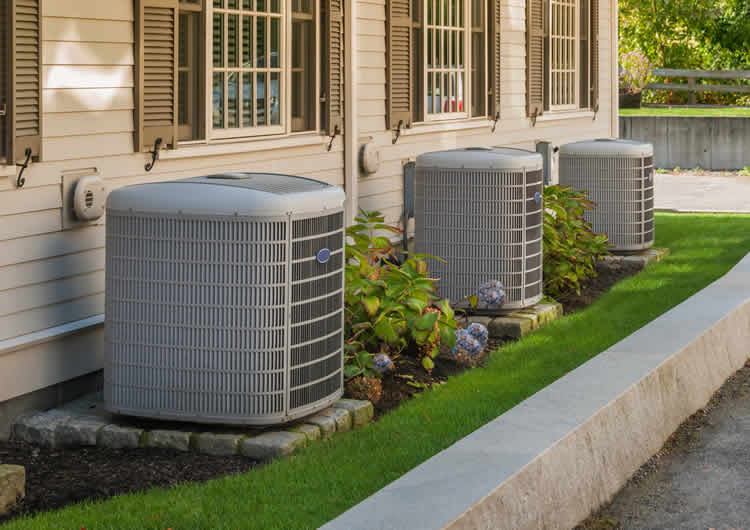
The outdoor condenser unit is the component most people picture when they think about “a new AC system,” and it represents roughly 30-40% of the total installed cost. A residential condenser unit in the 2 to 5-ton range costs $1,500 to $4,500 at the equipment level, before installation labor.
But a condenser alone is not a complete system. In most replacements, the indoor air handler or evaporator coil also needs to be replaced to match the new outdoor unit. Mismatched components — a new high-efficiency condenser paired with a 15-year-old air handler — operate below the advertised efficiency rating and can create refrigerant management problems that shorten the lifespan of both components. The EPA’s transition from R-410A to R-454B refrigerant in new equipment manufactured after January 2025 has made matching even more critical, since R-454B systems require components specifically designed for the new refrigerant’s operating pressures and characteristics.
A matched system — new condenser plus new air handler or evaporator coil — costs $3,000 to $7,000 for the equipment alone. The spread depends on brand, efficiency tier, and system features like variable-speed compressors and communicating controls.
System Size: Getting the Tonnage Right
AC systems are sized in tons, where one ton equals 12,000 BTU per hour of cooling capacity. Residential systems in the Savannah area typically range from 2 tons for smaller homes and condos to 5 tons for larger homes over 2,500 square feet. The most common size in Pooler’s newer subdivisions — homes in the 1,800 to 2,400 square foot range built after 2005 — is 3 to 3.5 tons.
Bigger is not better when it comes to AC sizing. An oversized system cools the air quickly but shuts off before it has run long enough to adequately dehumidify. In Savannah, where humidity management is half the job of your AC system, an oversized unit leaves you with a house that hits the temperature setpoint but feels clammy and uncomfortable because the relative humidity stays above 55%. This is one of the most common installation mistakes in the Southeast, and it is caused by contractors who size systems using square footage rules of thumb instead of performing a proper Manual J load calculation.
An undersized system is equally problematic. It runs continuously on the hottest days without reaching setpoint, drives up energy bills, and puts excessive wear on the compressor. In Savannah’s peak summer — when outdoor temperatures hit 95°F with 75% humidity and the heat index pushes past 105°F — a system that is half a ton too small simply cannot keep up.
A Manual J load calculation accounts for your home’s square footage, insulation levels, window area and orientation, ceiling height, number of occupants, duct losses, and the specific climate data for your location. In the Savannah market, the Manual J calculation should reflect the design temperature of approximately 95°F dry bulb and 77°F wet bulb — numbers that account for the extreme humidity that separates coastal Georgia from drier southern markets. This calculation takes 30 to 60 minutes and is the only reliable method for determining the correct system size. Any contractor who sizes your system without one is guessing, and guessing costs you money in either comfort or efficiency for the next 15 years.
Efficiency Ratings: What SEER2 Means for Your Wallet
As of January 2023, the Department of Energy updated efficiency standards and testing procedures for HVAC equipment sold in the Southeast region. The new metric is SEER2 (Seasonal Energy Efficiency Ratio 2), which uses a more stringent testing protocol that produces lower numbers than the old SEER scale. A system that would have rated 16 SEER under the old method rates approximately 15.2 SEER2 under the new one. This is not a reduction in efficiency — it is a more accurate measurement of the same performance.
The minimum legal efficiency for new AC systems installed in the Southeast is 15 SEER2. Equipment at this baseline represents the most affordable option and costs $1,500 to $2,500 for the condenser unit. Mid-range systems at 16 to 18 SEER2 cost $2,500 to $4,000 and deliver noticeably lower operating costs. High-efficiency systems at 19 SEER2 and above cost $3,500 to $5,500 or more and offer the lowest possible energy bills, but the premium over mid-range equipment takes longer to recoup through savings.
The practical question is whether the higher upfront cost of a more efficient system pays back over its lifespan in the Savannah market. The answer depends on your electricity rate, system size, and how many months per year the system runs.
A 3-ton system operating 2,000 hours per year — a conservative estimate for Savannah’s extended cooling season — at an electricity rate of $0.13 per kilowatt-hour produces annual cooling costs of approximately $520 at 15 SEER2, $450 at 17 SEER2, and $390 at 20 SEER2. The difference between baseline and mid-range efficiency is about $70 per year, or $1,050 over 15 years. The difference between baseline and high efficiency is about $130 per year, or $1,950 over 15 years.
Given that the price premium for mid-range efficiency over baseline is typically $800 to $1,500 at the installed system level, the mid-range option pays for itself within 10 to 15 years in energy savings alone — and that calculation does not include the softer benefits of quieter operation, better humidity control, and lower stress on components that variable-speed systems provide. High-efficiency systems take longer to break even on pure energy math but offer the best comfort performance in Savannah’s demanding humidity conditions.
For most Savannah-area homeowners, the 16 to 18 SEER2 range represents the best value — meaningful energy savings over baseline without the steep premium of top-tier equipment.
Brand Pricing: What You Are Really Paying For
HVAC equipment is manufactured by a handful of large corporations that produce multiple brand names at different price tiers. Understanding the brand landscape helps you evaluate whether a premium brand is worth the extra cost or whether a mid-tier brand delivers equivalent performance for less money.
The premium tier includes brands like Carrier, Trane, and Lennox. These manufacturers charge the highest equipment prices — typically 15-30% more than mid-tier options — and justify the premium through longer warranty coverage, proprietary features, and brand reputation. A 3-ton Carrier or Trane system at 17 SEER2 might cost $3,500 to $4,500 for the equipment, compared to $2,500 to $3,500 for an equivalent-spec mid-tier system.
The mid tier includes brands like Goodman, Amana, Rheem, and Ruud. These are not inferior products — Goodman and Amana are manufactured by Daikin, one of the largest HVAC manufacturers in the world. Rheem and Ruud are made by the same parent company. Mid-tier systems use comparable compressors (often the same Copeland or Bristol compressors found in premium brands), similar coil construction, and equivalent refrigerant management. The primary differences are in warranty length, aesthetic finish, and advanced features at the top of each product line.
For a standard residential replacement in Pooler or Savannah where the homeowner wants reliable, efficient cooling without paying for features they will never use, a mid-tier brand at 16-17 SEER2 provides excellent value. The equipment cost savings of $1,000 to $2,000 versus a premium brand can be redirected toward a higher efficiency rating, a better thermostat, or simply kept in your pocket.
Labor and Installation: Where Quality Matters Most
Equipment selection gets most of the homeowner’s attention, but installation quality has a larger impact on long-term system performance than brand or efficiency rating. A premium system installed poorly will underperform a mid-tier system installed correctly — and the difference compounds over 15 years of operation.
Installation labor in the Savannah market typically costs $2,000 to $4,500 and covers removal and disposal of the old equipment, placement and connection of the new condenser and air handler, refrigerant line connection and charging, electrical wiring, thermostat installation or integration, condensate drain connection, system startup and commissioning, and permit filing with the local building authority.
The quality differentiators in installation are not visible to most homeowners but are critically important. Proper refrigerant line sizing and brazing technique prevent leaks and ensure correct system performance. Refrigerant charge must be weighed to the manufacturer’s exact specification — not estimated with gauges alone. Airflow across the evaporator coil must be verified and adjusted if necessary. Electrical connections must be tight and properly rated. And the system must be commissioned — started up and tested through a full cooling cycle with measurements documented — before the installer leaves.
Permit requirements in Chatham County and the City of Pooler require a mechanical permit for HVAC system replacements. A licensed contractor pulls this permit, the work is performed, and a county inspector verifies that the installation meets code. Contractors who skip the permit process are saving themselves time and fees at your expense — unpermitted work can create problems during home sales, insurance claims, and warranty disputes.
Additional Costs That Affect the Final Number
Several factors outside the core equipment and labor can push an installation above the base price range. None of these are upsells — they are legitimate scope items that vary by home.
Ductwork modifications are the most common adder. If your existing ductwork is undersized, damaged, or poorly sealed, the new system cannot perform to its rated efficiency regardless of how good the equipment is. Duct sealing — using mastic or aerosol sealant to close leaks in the duct system — costs $300 to $800 and can improve system efficiency by 10-20% in homes with older ductwork. Duct replacement or significant modification is a larger project at $2,000 to $5,000 but may be necessary in homes where the original ductwork was undersized or has deteriorated.
Electrical upgrades may be needed if your current electrical panel cannot support the new equipment or if the disconnect and wiring at the condenser location are not up to current code. This is most common in older Savannah homes where the original electrical service was sized for smaller AC systems than what is being installed. Electrical work adds $200 to $1,000 depending on scope.
A new thermostat is often included in the installation price, but upgrading to a smart thermostat like an Ecobee or Google Nest adds $100 to $250 over a standard programmable unit. In Savannah’s climate, a smart thermostat with humidity sensing capability provides genuine value by adjusting the cooling cycle to optimize both temperature and humidity rather than managing temperature alone.
The concrete pad under the outdoor condenser may need replacement if it has cracked or settled unevenly. A new condenser pad costs $50 to $200 — minor in the context of a system installation but worth addressing since a level pad reduces vibration stress on refrigerant line connections.
How to Compare Quotes
When you have two or three quotes in hand, compare them on equivalent terms. A $7,000 quote and a $9,000 quote are not comparable if one includes a 17 SEER2 system with a new air handler and the other includes a 15 SEER2 condenser only with the existing air handler retained.
For each quote, confirm the equipment brand and model numbers (which you can look up independently to verify specifications), the SEER2 rating, whether both the condenser and air handler are being replaced, the warranty terms, whether a Manual J load calculation was performed, whether permits are included, and the payment terms.
Get a minimum of two quotes and ideally three. Do not automatically choose the lowest — it may reflect cut corners on installation quality, skipped permits, or equipment that is not properly matched. Do not automatically choose the highest either — premium pricing does not always correlate with premium workmanship. The best value is typically the contractor who demonstrates technical competence through a proper load calculation, explains their equipment recommendation clearly, and provides a detailed written proposal that you can compare against competing bids.
What Carriage Provides in Every Installation
At Carriage Heating & Cooling, every system replacement begins with a Manual J load calculation to ensure correct sizing for your specific home. We provide detailed written proposals that itemize equipment, labor, permits, and any additional scope so you can compare our quote against any other bid on equal terms. We work with all major brands and recommend equipment based on your budget, efficiency goals, and home requirements — not based on which manufacturer is running the highest dealer incentive this quarter.
We pull all required permits through Chatham County, and every installation is inspected. Financing is available for homeowners who prefer to spread the investment over time. Call (912) 306-0375 for a free replacement estimate anywhere in Pooler, Savannah, Richmond Hill, or the surrounding area.