Do I Need Air Duct Cleaning? How to Tell (And How Often)
Most homes in the Savannah area do not need duct cleaning on a regular schedule — but specific conditions make it genuinely worthwhile, and knowing the difference between necessary service and unnecessary upsell saves you $300 to $600 per cleaning.
You likely need duct cleaning if you can see visible mold growth on or around your supply registers, if your ducts have not been cleaned in the entire time you have owned the home and you are experiencing unexplained dust or allergy symptoms indoors, if you have recently completed a renovation that generated construction dust, or if you have confirmed pest activity inside the duct system.
Outside of these situations, money spent on duct cleaning is almost always better spent on evaporator coil cleaning, filter upgrades, and humidity management — interventions that address the actual sources of indoor air quality problems rather than the distribution pathway.
This is one of the most oversold services in residential HVAC, and the overselling creates a credibility problem that hurts homeowners who actually do need their ducts cleaned. Aggressive duct cleaning companies — some of which advertise suspiciously low prices ($49 to $99 whole-house specials) as a foot-in-the-door tactic — have made homeowners either skeptical of all duct cleaning or anxious that they are breathing dangerous air because they have never had it done. The reality is more nuanced than either position. Here is how to evaluate your specific situation honestly.
What the EPA Actually Says
The EPA’s position on residential duct cleaning is frequently cited but rarely quoted accurately. Their published guidance states that duct cleaning has never been shown to actually prevent health problems, and that studies do not conclusively demonstrate that particle levels in homes increase because of dirty air ducts. They neither recommend for nor against routine duct cleaning in the absence of specific indicators.
What the EPA does recommend is duct cleaning in specific circumstances: when there is substantial visible mold growth inside ducts or on other components of the HVAC system, when ducts are infested with vermin (rodents or insects), or when ducts are clogged with excessive amounts of dust and debris that are actually being released into the living space through the supply registers.
This is a measured, evidence-based position that frustrates both the duct cleaning industry (which wants an endorsement of regular cleaning) and the skeptics (who want a flat declaration that duct cleaning is unnecessary). The EPA’s position essentially says: clean your ducts when there is a specific, identifiable reason to do so, not on a calendar schedule.
For Savannah homeowners, this guidance needs local context. The EPA’s position was developed for national conditions. Savannah’s extreme humidity, the prevalence of attic-mounted ductwork in superheated spaces, and the biological growth potential in this climate create conditions that make duct contamination more likely here than in most markets. The EPA’s triggers — visible mold, vermin, excessive debris — are more frequently present in Savannah homes than in homes in drier, cooler regions.
The Honest Indicators: When Duct Cleaning Makes Sense
Several specific situations warrant professional duct cleaning in the Savannah market. These are not vague concerns about “air quality” — they are observable, verifiable conditions that you can check yourself before calling a company.
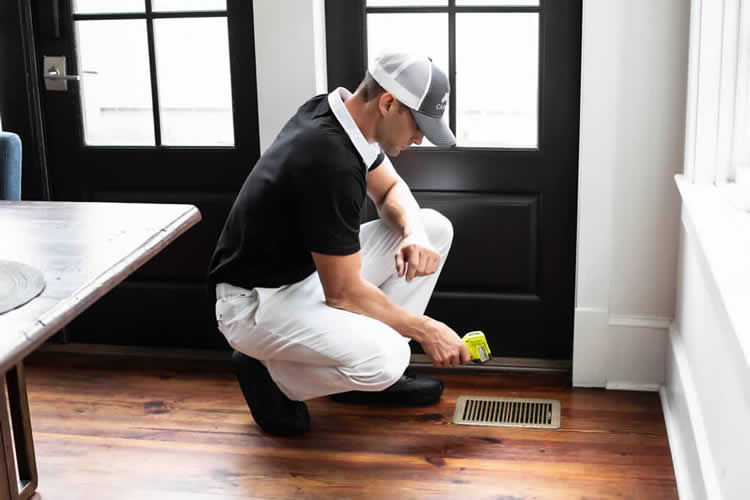
Visible mold on or around supply registers is the most reliable indicator that the duct system has a contamination problem. Remove a supply register cover and look at the interior surface of the register boot — the sheet metal or flex duct connection between the register and the main duct run. If you see dark discoloration, fuzzy growth, or a slimy film, the duct interior has conditions supporting biological growth. Check multiple registers throughout the house, not just one.
Mold on a single register near an attic hatch or in a bathroom may indicate a localized moisture issue at that specific duct connection. Mold on registers throughout the house indicates a systemic problem in the duct system.
In Savannah homes where ductwork runs through unconditioned attics — which describes the majority of homes built after 1990 in Pooler, Richmond Hill, and Savannah’s suburban neighborhoods — condensation on the exterior of poorly insulated duct sections is the primary moisture source for duct-based mold.
The temperature differential between cool supply air inside the duct (55°F to 60°F) and the attic air surrounding it (130°F to 150°F in summer) causes condensation on any section where the insulation has deteriorated, separated from the duct liner, or was inadequate from the original installation. That condensation migrates to the duct interior and creates the wet conditions mold requires.
Post-renovation cleaning is straightforward and time-limited. If you have completed any project that generated significant airborne debris — drywall installation or removal, sanding, demolition, cabinet installation, or flooring work — and the HVAC system ran during any part of that work, construction dust is inside your ducts.
This dust is heavier and grittier than normal household dust, and it does not filter out naturally over time. It sits in the duct runs, becomes airborne every time the system cycles on, and settles on every surface in the house repeatedly until it is removed from the ducts. Post-renovation duct cleaning is a one-time expense that solves a one-time problem.
Evidence of pest activity inside ducts includes droppings visible through supply registers, scratching or movement sounds from within the duct runs when the system is off, or insect debris (wings, casings, dead insects) on or near register openings. In the Savannah area, the pests most commonly found in ductwork are palmetto bugs (American cockroaches), which enter through gaps in duct connections and find the enclosed, temperature-controlled environment hospitable, and rodents, which occasionally access duct systems through exterior wall penetrations or damaged duct sections in attics and crawl spaces.
Pest activity leaves biological debris — droppings, shed exoskeletons, dander, urine traces — that becomes airborne when the system runs and constitutes a genuine health concern.
Persistent unexplained dust accumulation that exceeds what you consider normal for your household, despite regular cleaning and a properly maintained filter, may indicate that the duct system is releasing particulates into the living space.
This is a softer indicator than visible mold or pest evidence because “excessive dust” is subjective and can have multiple causes. But if you have upgraded your filter to MERV-10 or higher, you are replacing it on schedule, and you are still wiping heavy dust from surfaces within days of cleaning, the ducts are a reasonable place to investigate.
Previous occupant history matters in recently purchased homes. If the prior owners had multiple pets, were smokers, or clearly did not maintain the HVAC system (a dirty coil, a clogged drain line, and a filter that looks like it has been in place for a year are strong indicators), the duct system has absorbed years of contaminated air. Duct cleaning in a newly purchased home with unknown maintenance history is reasonable insurance — you are starting fresh with a system you did not contaminate and cannot evaluate based on personal experience.
When Duct Cleaning Is Not Necessary
Several situations that duct cleaning companies use as selling points do not actually warrant the service.
Normal dust on register faces is not an indicator of duct contamination. Every supply register in every home accumulates dust on the grille surface where conditioned air exits into the room. This is dust from the room being drawn toward the register by air currents, not dust being blown out of the duct system. Wipe the register with a damp cloth and move on.
A general desire to “improve air quality” without specific symptoms or observable contamination is not a reason to clean ducts. The $300 to $600 cost of duct cleaning would almost always deliver a bigger air quality improvement if spent on evaporator coil cleaning ($200 to $500) and a year’s worth of quality filters ($80 to $160) — because the coil and filter address the primary sources of indoor air contamination, while ducts are a secondary pathway.
The passage of time alone — “it’s been five years since we cleaned them” — does not necessitate duct cleaning if none of the specific indicators above are present. Ducts in a well-maintained system with a quality filter that is replaced on schedule accumulate minimal debris because the filter captures particles before they enter the duct system. A system that has been properly filtered and maintained for five years has clean ducts regardless of when they were last professionally cleaned.
An HVAC tune-up that concludes with a duct cleaning recommendation deserves scrutiny. Some companies use the maintenance visit as a lead generation tool for duct cleaning services, and the recommendation may be based on a financial incentive rather than an objective assessment of your ductwork condition. If a technician recommends duct cleaning, ask to see the evidence — photos inside the duct, a mirror showing the register boot interior, or a specific description of what they found. “Your ducts are dirty” is not a diagnosis. “I can see visible mold growth on the interior of the supply plenum and on two register boots” is.
What Professional Duct Cleaning Actually Involves
A legitimate duct cleaning service follows a defined process that takes three to five hours for a typical residential system with 8 to 15 supply runs and two to four return runs.
The process begins with a visual inspection of the duct system at accessible points — supply and return registers, the supply plenum, and any access points in the duct runs themselves. This inspection establishes the baseline condition and identifies areas of concentrated contamination that need focused attention.
The technician seals all supply registers except the one being actively cleaned, which creates negative pressure in the duct system when connected to a high-powered vacuum. The vacuum — either a truck-mounted unit with a collection tank or a large portable unit — connects to the main trunk line and runs continuously during the cleaning process, pulling dislodged debris toward the collection point.
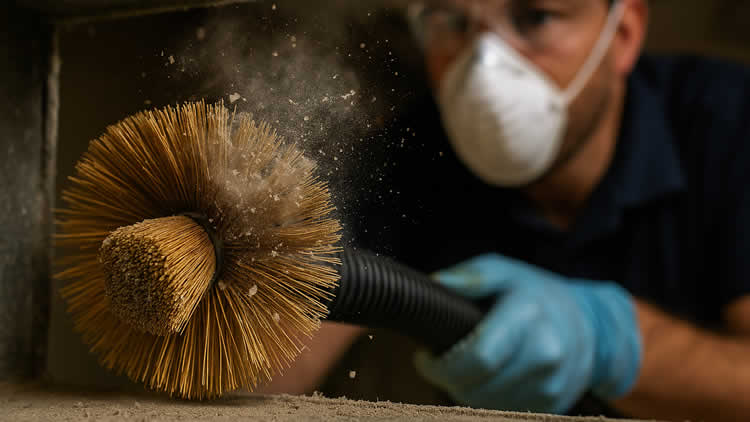
Each supply and return duct run is cleaned individually using one or more agitation methods. Compressed air whips — flexible lines with air nozzles that rotate inside the duct — blast debris off the duct interior surfaces and propel it toward the vacuum collection point. Rotary brushes physically scrub the duct walls, which is more effective for stuck-on debris but cannot be used in flex duct without risking damage to the inner liner. Contact vacuuming uses a hose inserted directly into each duct run to vacuum surface debris.
After the individual runs are cleaned, the main trunk lines, supply plenum, return plenum, and air handler cabinet are cleaned. The evaporator coil and blower wheel should be cleaned as part of a comprehensive service — cleaning the ducts while leaving a contaminated coil and blower in place means the freshly cleaned ducts will be recontaminated by the first source of biological material in the system within weeks.
Some companies apply an antimicrobial sealant or fogging treatment to the duct interior after cleaning. The EPA’s position on chemical treatments inside ductwork is cautious — they note that while some antimicrobial products are EPA-registered for use in duct systems, chemical treatments have not been proven to prevent mold regrowth in ducts and may introduce chemicals into the air stream that cause their own health concerns. If a company recommends a post-cleaning treatment, ask for the specific product name and its EPA registration number, and research it independently before consenting.
Pricing and What to Watch For
Legitimate duct cleaning in the Savannah market costs $300 to $600 for a standard residential system, with pricing varying based on the number of duct runs, system accessibility, and the level of contamination. Homes with two HVAC systems (common in larger two-story homes) cost more because there are two complete duct networks to clean.
Be deeply skeptical of companies advertising duct cleaning for $49, $79, or $99 for a whole house. These prices are mathematically impossible for a legitimate service — the labor hours and equipment cost alone exceed these rates. Low-ball pricing is a classic bait-and-switch strategy in the duct cleaning industry.
The company arrives, performs a minimal service (vacuuming a few register boots), then “discovers” severe contamination that requires an additional $500 to $1,500 in treatments, antimicrobial applications, or emergency remediation. The final bill exceeds what a legitimate company would have charged for the same work quoted honestly upfront.
Verify that the company follows NADCA (National Air Duct Cleaners Association) standards. NADCA certification is not legally required, but it establishes a baseline standard of practice that protects the homeowner. NADCA-certified companies must clean all components of the HVAC system — not just the ducts — and must use source removal methods (agitation plus vacuum collection) rather than just spraying chemical treatments into the ductwork.
Ask whether the quoted price includes the evaporator coil and blower wheel cleaning. Some companies quote duct cleaning only and then add coil and blower cleaning as a separate charge. Since cleaning the ducts without cleaning the coil is addressing the symptom while ignoring the source, a comprehensive quote that includes all components is both more effective and easier to evaluate against competing bids.
How Often: The Realistic Schedule for Savannah
There is no universally correct cleaning interval because the rate of duct contamination depends on variables specific to your home — filter quality and replacement frequency, system age, ductwork location and condition, household factors (pets, smoking, occupant count), and whether the system has UV coil treatment or other contamination controls.
For homes with well-maintained systems — MERV-10 or higher filter replaced monthly, annual professional coil and blower cleaning, functioning condensate drain, no UV treatment — duct cleaning every five to seven years is a reasonable guideline in Savannah’s climate. The filter catches most airborne particles before they enter the ductwork, and the annual coil cleaning prevents the air handler from being a contamination source.
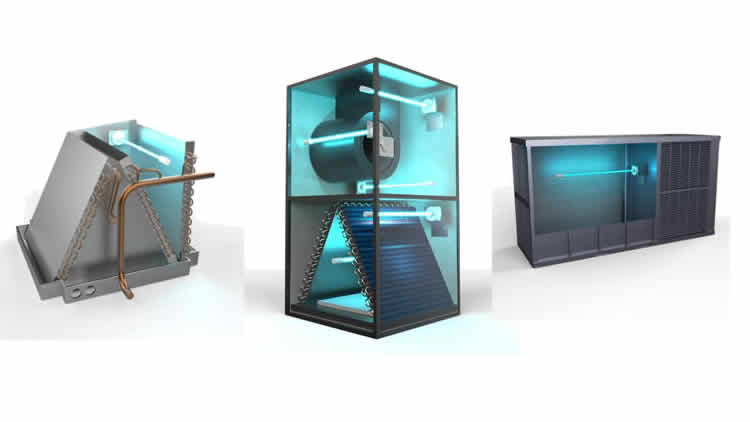
For homes with UV coil irradiation, proper filtration, and annual maintenance, duct cleaning may not be needed for 7 to 10 years or longer, since the primary source of biological contamination (the coil) is continuously controlled and the filter is preventing particulate accumulation.
For homes with deferred maintenance — systems that have not had professional coil cleaning in two or more years, filters that are changed infrequently or are low MERV, no UV treatment — duct contamination accumulates faster. These homes benefit from duct cleaning every three to five years, combined with bringing the air handler maintenance up to an appropriate standard so the cleaning lasts.
For homes with specific triggers — completed renovations, confirmed pest activity, or visible mold — clean the ducts in response to the trigger regardless of the last cleaning date, then resume the interval-based schedule above.
The Better Investment Hierarchy
If you have a fixed budget for improving your indoor air quality, spending it in the right order matters more than spending it on the most dramatic-sounding service.
First, upgrade your filter to MERV-10 or MERV-11 and commit to replacing it every 30 to 45 days during cooling season. Annual cost: $80 to $160. Impact: immediate and significant reduction in airborne particulates throughout the house.
Second, get the evaporator coil and blower wheel professionally cleaned. Cost: $200 to $500. Impact: eliminates the single largest source of biological contamination in the system and removes the musty startup smell.
Third, clear and treat the condensate drain. Cost: $75 to $150 standalone, or included in a maintenance visit. Impact: eliminates standing water and biological growth in the drain pan.
Fourth, consider UV coil irradiation if the coil recontaminates rapidly between annual cleanings. Cost: $500 to $1,200 installed. Impact: continuous mold prevention on the coil surface.
Fifth — after all of the above are addressed — consider duct cleaning if specific indicators are present. Cost: $300 to $600. Impact: removes accumulated contamination from the distribution pathway, which matters most after the source (the air handler) has been addressed.
This order maximizes the return on each dollar spent because it addresses contamination sources before distribution pathways. Cleaning the ducts while leaving a moldy coil and a clogged filter in place is like mopping the floor while the faucet is still running.
At Carriage Heating & Cooling, we evaluate duct cleaning as part of a comprehensive air quality assessment — not as a standalone upsell. If your ducts need cleaning, we tell you why with specific evidence. If they do not, we tell you that too and recommend where your money would make a bigger impact. Call (912) 306-0375 for an honest assessment anywhere in Pooler, Savannah, Richmond Hill, Tybee Island, or the surrounding area.